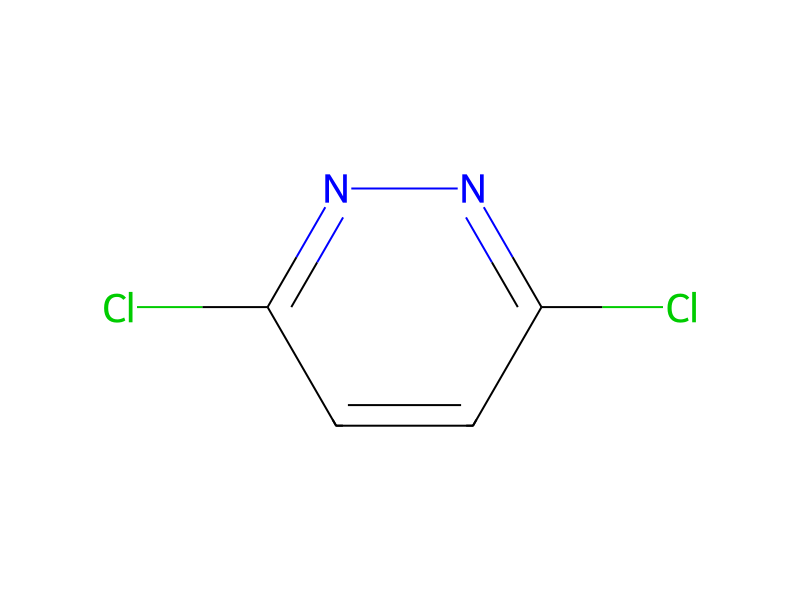
3,6-Dichloropyridazine → HCID 19095533, compound
Reaction equation

[Cl:1][C:2]1[N:3]=[N:4][C:5](Cl)=[CH:6][CH:7]=1.[N:9]1[CH:14]=[CH:13][CH:12]=[CH:11][C:10]=1[N:15]1[CH2:20][CH2:19][NH:18][CH2:17][CH2:16]1.C(=O)([O-])O.[Na+]>C(O)C>[Cl:1][C:2]1[N:3]=[N:4][C:5]([N:18]2[CH2:19][CH2:20][N:15]([C:10]3[CH:11]=[CH:12][CH:13]=[CH:14][N:9]=3)[CH2:16][CH2:17]2)=[CH:6][CH:7]=1Participants
Reactant 3


Product 1

Reagents, catalysts & solvents 1

Procedure
A mixture of 3.3 parts of 3.6-dichloropyridazine, 3.3 parts of 1-(2-pyridinyl)piperazine. 1.5 parts of sodium hydrogencarbonate and 120 parts of ethanol was stirred and refluxed over weekend. The reaction mixture was evaporated. Water was added to the residue and the product was extracted with dichloromethane. The extract was dried, filtered and evaporated. The residue was purified by column chromatography over silica gel using a mixture of trichloromethane and methanol (99:1 by volume) as eluent. The pure fractions were collected and the eluent was evaporated. The residue was crystallized from a mixture of 2-propanol and tetrahydrofuran, yielding 2.5 parts (45.3%) of 3-chloro-6-[4-(2-pyridinyl)-1-piperazinyl]pyridazine; mp. 194.7° C. (compound 213).
Workup
- temperaturerefluxed over weekend
- customThe reaction mixture was evaporated
- additionWater was added to the residue
- extractionthe product was extracted with dichloromethane
- customThe extract was dried
- filtrationfiltered
- customevaporated
- customThe residue was purified by column chromatography over silica gel using
- additiona mixture of trichloromethane and methanol (99:1 by volume) as eluent
- customThe pure fractions were collected
- customthe eluent was evaporated
- customThe residue was crystallized from a mixture of 2-propanol and tetrahydrofuran
Sources & evidence
- ORD record
- ord-bf36a5459c3043c7811befb0211ebefb
- Source dataset
- uspto-grants-1994_03
- Patent number
- US05292738
Reaction notes
Loading…