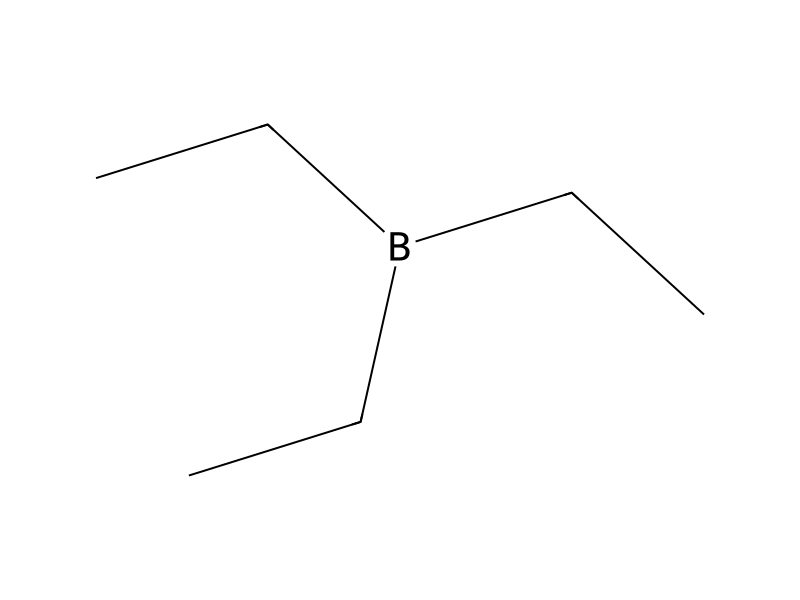
Triethylborane → HCID 15675441, compound
Reaction equation

[OH:1][CH2:2][CH2:3][C@@H:4]([OH:13])[CH2:5][C:6](=[O:12])[CH2:7][CH2:8]/[CH:9]=[CH:10]/[CH3:11].C(B(CC)CC)C.[BH4-].[Na+].C(=O)([O-])O.[Na+]>O1CCCC1.CO>[OH:1][CH2:2][CH2:3][C@@H:4]([OH:13])[CH2:5][C@@H:6]([OH:12])[CH2:7][CH2:8]/[CH:9]=[CH:10]/[CH3:11]Participants






Conditions
- Temperature
- -70 °C
Procedure
1 g (5.4 mmol) of compound 2b from Example 10 is stirred at room temperature in 50 ml of tetrahydrofuran with 8.6 ml of a 1 molar triethylborane solution in tetrahydrofuran (8.6 mmol) for 15 min. After cooling to -70° C., 4.3 ml of methanol and 0.4 g (10.7 mmol) of sodium borohydride are added and the reaction mixture is stirred at this temperature for a further 3 h. For working-up, 30 ml of a saturated sodium hydrogen carbonate solution are added to the mixture and it is extracted three times using 100 ml of ethyl acetate in each case. The ester phase is dried over sodium sulfate After filtering off, the solvent is removed by distillation in vacuo and an oily product is obtained. This is treated with methanol a further five times and distilled in vacuo so that excess borane is removed The residue which remains is purified on silica gel using acetone:hexane (2:3) and gives the compound 3c in a yield of 0.84 g (83%) as a colorless oil.
Workup
- extractionis extracted three times
- dry with materialThe ester phase is dried over sodium sulfate
- filtrationAfter filtering off
- customthe solvent is removed by distillation in vacuo
- customan oily product is obtained
- distillationdistilled in vacuo so that excess borane
- customis removed The residue which
- customremains is purified on silica gel
Sources & evidence
- ORD record
- ord-df491c31200e4b80bcdfbf0cefd25c81
- Source dataset
- uspto-grants-1994_03
- Patent number
- US05292898
Reaction notes
Loading…