Dodecanoyl chloride → HCID 19019876, compound
Reaction equation

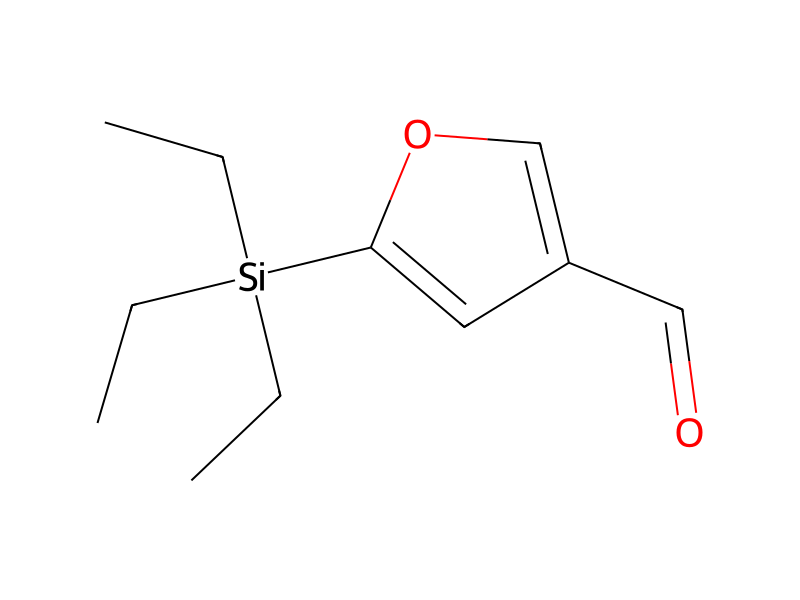
[OH:1][CH:2]([C:5]1[CH:6]=[C:7]([Si:10]([CH2:15][CH3:16])([CH2:13][CH3:14])[CH2:11][CH3:12])[O:8][CH:9]=1)[CH2:3][OH:4].C([Si](CC)(CC)C1OC=C(C=O)C=1)C.C[Si](C1C=COC=1C=O)(C)C.[C:42](Cl)(=[O:54])[CH2:43][CH2:44][CH2:45][CH2:46][CH2:47][CH2:48][CH2:49][CH2:50][CH2:51][CH2:52][CH3:53]>C(N(CC)CC)C>[OH:1][CH:2]([C:5]1[CH:6]=[C:7]([Si:10]([CH2:13][CH3:14])([CH2:11][CH3:12])[CH2:15][CH3:16])[O:8][CH:9]=1)[CH2:3][O:4][C:42](=[O:54])[CH2:43][CH2:44][CH2:45][CH2:46][CH2:47][CH2:48][CH2:49][CH2:50][CH2:51][CH2:52][CH3:53]Participants
6




Procedure
4-(1,2-Dihydroxyethyl)-2-triethylsilylfuran (prepared substantially as described above using 5-triethylsilyl-3-furaldehyde in place of the corresponding trimethylsilyl furaldehyde) is reacted with dodecanoyl chloride in the presence of triethylamine to give 4-(1-hydroxy-2-dodecanoyloxyethyl)-2-triethylsilylfuran. Treating this 1-hydroxy compound with acetic anhydride and pyridine gives 4-(1-acetoxy-2-dodecanoyl-oxyethyl)-2-triethylsilylfuran.
Sources & evidence
- ORD record
- ord-9b7dec9a1b4e4492bca6710952534c2d
- Source dataset
- uspto-grants-1994_03
- Patent number
- US05298633
Reaction notes
Loading…