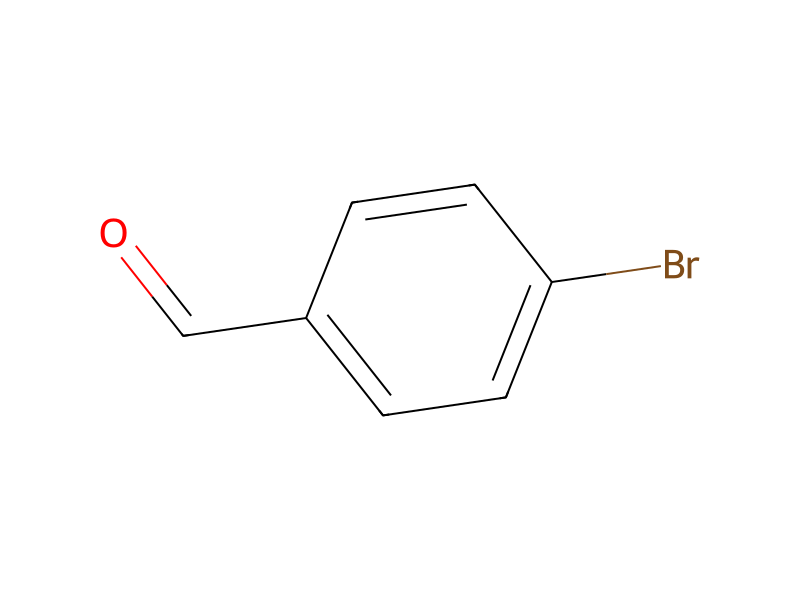
4-Bromobenzaldehyde → 4-(1,3-Thiazol-2-yl)benzaldehyde
Reaction equation

Br[C:2]1[CH:9]=[CH:8][C:5]([CH:6]=[O:7])=[CH:4][CH:3]=1.C([Sn](CCCC)(CCCC)[C:15]1[S:16][CH:17]=[CH:18][N:19]=1)CCC>CC#N.C1(P(C2C=CC=CC=2)C2C=CC=CC=2)C=CC=CC=1.C1(P(C2C=CC=CC=2)C2C=CC=CC=2)C=CC=CC=1.[Pd](Cl)Cl>[S:16]1[CH:17]=[CH:18][N:19]=[C:15]1[C:2]1[CH:9]=[CH:8][C:5]([CH:6]=[O:7])=[CH:4][CH:3]=1Participants
5



Conditions
- Temperature
- 60 °C
Procedure
To a solution of 0.500 g (2.70 mmol) of 4-bromobenzaldehyde and 1.00 g (2.67 mmol) of 2-tributylstannylthiazole in MeCN (25 mL), degassed by bubbling N2 through for 10 min, was added 0.100 g (0.140 mmol) of palladium dichloride bis(triphenylphosphine). The mixture was heated to 60° C. for 15 h. The mixture was cooled to room temperature and filtered through diatomaceous earth. The mixture was diluted with H2O and washed with EtOAc. The combined organic phase was dried over anhydrous Na2SO4 and concentrated under reduced pressure. The residue was purified by flash silica gel chromatography to provide 0.400 g (79.1%) of 4-thiazol-2-yl-benzaldehyde as a yellow solid.
Workup
- customby bubbling N2 through for 10 min
- temperatureThe mixture was cooled to room temperature
- filtrationfiltered through diatomaceous earth
- additionThe mixture was diluted with H2O
- washwashed with EtOAc
- dry with materialThe combined organic phase was dried over anhydrous Na2SO4
- concentrationconcentrated under reduced pressure
- customThe residue was purified by flash silica gel chromatography
Sources & evidence
- ORD record
- ord-7d47ed4879164c7b87c55f8509480aad
- Source dataset
- uspto-grants-2005_12
- Patent number
- US06974870B2
Reaction notes
Loading…