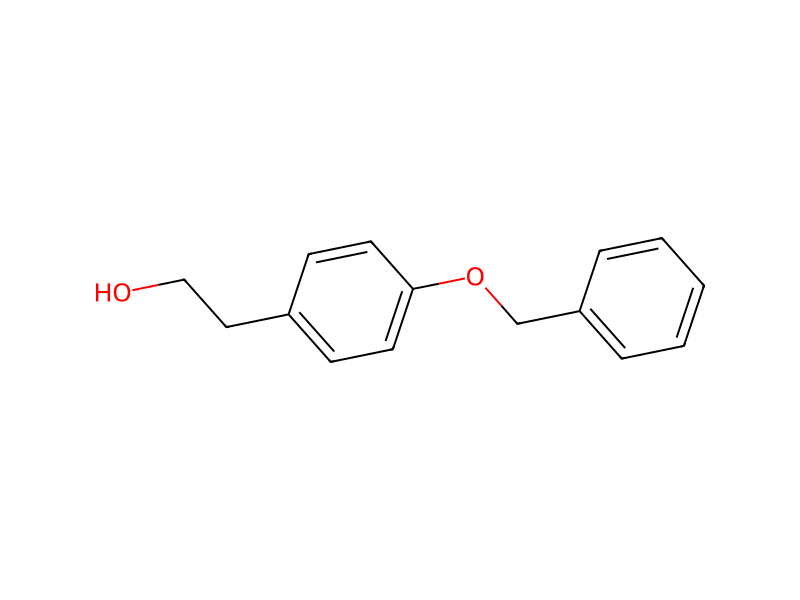
Benzyl Bromide → p-(Benzyloxy)phenethyl alcohol
Reaction equation

[OH:1][CH2:2][CH2:3][C:4]1[CH:9]=[CH:8][C:7]([OH:10])=[CH:6][CH:5]=1.C(=O)([O-])[O-].[K+].[K+].[CH2:17](Br)[C:18]1[CH:23]=[CH:22][CH:21]=[CH:20][CH:19]=1>C(O)C>[CH2:17]([O:10][C:7]1[CH:8]=[CH:9][C:4]([CH2:3][CH2:2][OH:1])=[CH:5][CH:6]=1)[C:18]1[CH:23]=[CH:22][CH:21]=[CH:20][CH:19]=1Participants
5
Reactant 3



Product 1
Reagents, catalysts & solvents 1

Procedure
To a solution of 4-(2-hydroxy-ethyl)-phenol (50 g, 0.36 mol) in ethanol (400 ml) is added potassium carbonate (75 g, 0.54 mol, 1.5 eq) and benzyl bromide (47.2 ml, 0.39 mol, 1.1 eq), the reaction mixture is stirred at room temperature overnight. The reaction mixture is then filtered off trough celite and concentrated under vacuum. 2-(4-Benzyloxy-phenyl)-ethanol is isolated after crystallization with diethyl ether (82.6 g, 95%).
Workup
- filtrationThe reaction mixture is then filtered off trough celite
- concentrationconcentrated under vacuum
Sources & evidence
- ORD record
- ord-ad32d45293da40d0913a57adb51923e1
- Source dataset
- uspto-grants-2009_05
- Patent number
- US07528120B2
Reaction notes
Loading…