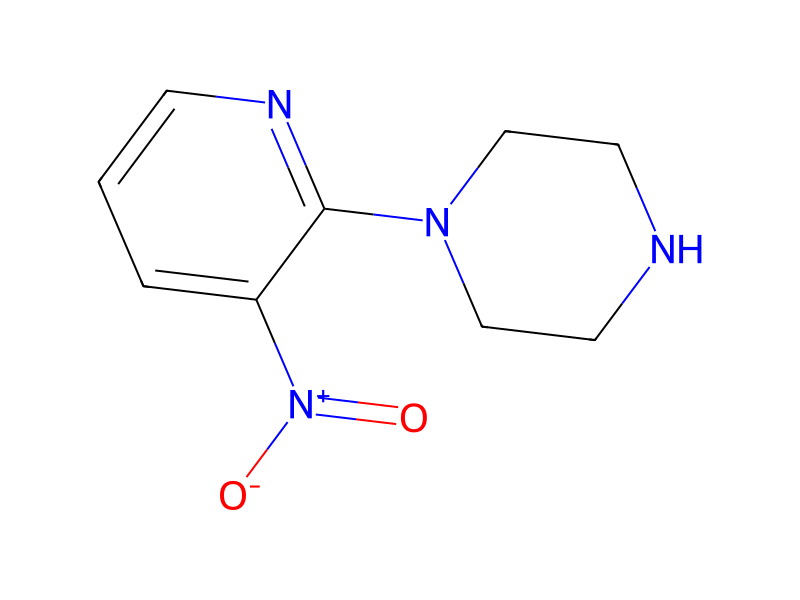
Piperazine → 1-(3-Nitropyridin-2-yl)piperazine
Reaction equation

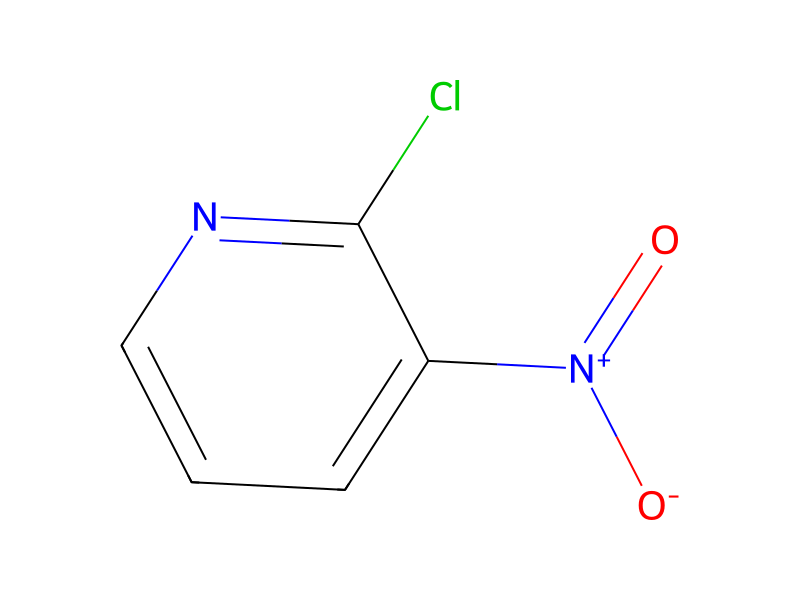
Cl[C:2]1[C:7]([N+:8]([O-:10])=[O:9])=[CH:6][CH:5]=[CH:4][N:3]=1.[NH:11]1[CH2:16][CH2:15][NH:14][CH2:13][CH2:12]1>C(O)(C)C>[N+:8]([C:7]1[C:2]([N:11]2[CH2:16][CH2:15][NH:14][CH2:13][CH2:12]2)=[N:3][CH:4]=[CH:5][CH:6]=1)([O-:10])=[O:9]Participants
4
Reactant 2

Product 1
Reagents, catalysts & solvents 1

Procedure
To a solution of 2-chloro-3-nitropyridine (10.05 g, 63.39 mmol) in isopropyl alcohol (350 mL) at room temperature was added piperazine (27.48 g, 319.0 mmol) in one portion. After 2 hours, the solvent was removed under reduced pressure and the residue partitioned between water and dichloromethane. The organic phase was dried (sodium sulfate), filtered and concentrated to a bright yellow solid. This material was used without further purification. 1H NMR (300 MHz, CDCl3) δ 1.74 (s, 1H), 2.98 (m, 4H), 3.43 (m, 4H), 6.73 (dd, 1H, J=8.1, 4.8 Hz), 8.11 (dd, 1H, J=8.1, 1.7 Hz), 8.32 (dd, 1H, J=4.4, 1.7 Hz); MS (DCI/NH3) m/e 209 (M+H)+.
Workup
- customthe solvent was removed under reduced pressure
- customthe residue partitioned between water and dichloromethane
- dry with materialThe organic phase was dried (sodium sulfate)
- filtrationfiltered
- concentrationconcentrated to a bright yellow solid
- customThis material was used without further purification
Sources & evidence
- ORD record
- ord-e54b0f3668714d4d931b337124fde7a5
- Source dataset
- uspto-grants-2009_05
- Patent number
- US07528134B2
Reaction notes
Loading…