Ethylmorpholine → HCID 86610815, compound
Reaction equation

[S:1]([NH:17][CH2:18][CH2:19][CH2:20][CH2:21][C@@H:22]([C:24]([OH:26])=[O:25])[NH2:23])([C:4]1[C:16]2[CH:15]=[CH:14][CH:13]=[C:9]([N:10]([CH3:12])[CH3:11])[C:8]=2[CH:7]=[CH:6][CH:5]=1)(=[O:3])=[O:2].C(N1[CH2:34][CH2:33][O:32]CC1)C.C[O:36][CH:37](OC)[C:38]1[CH:43]=C[C:41](C(O)=O)=[CH:40][CH:39]=1.S(N[C@H](C(O)=O)CCCCN)(C1C2C=CC=C(N(C)C)C=2C=CC=1)(=O)=O>CN(C)C=O.C(O)(=O)C>[S:1]([NH:17][CH2:18][CH2:19][CH2:20][CH2:21][C@@H:22]([C:24]([OH:26])=[O:25])[NH:23][C:33](=[O:32])[C:34]1[CH:41]=[CH:40][CH:39]=[C:38]([CH:37]=[O:36])[CH:43]=1)([C:4]1[C:16]2[CH:15]=[CH:14][CH:13]=[C:9]([N:10]([CH3:12])[CH3:11])[C:8]=2[CH:7]=[CH:6][CH:5]=1)(=[O:2])=[O:3]Participants
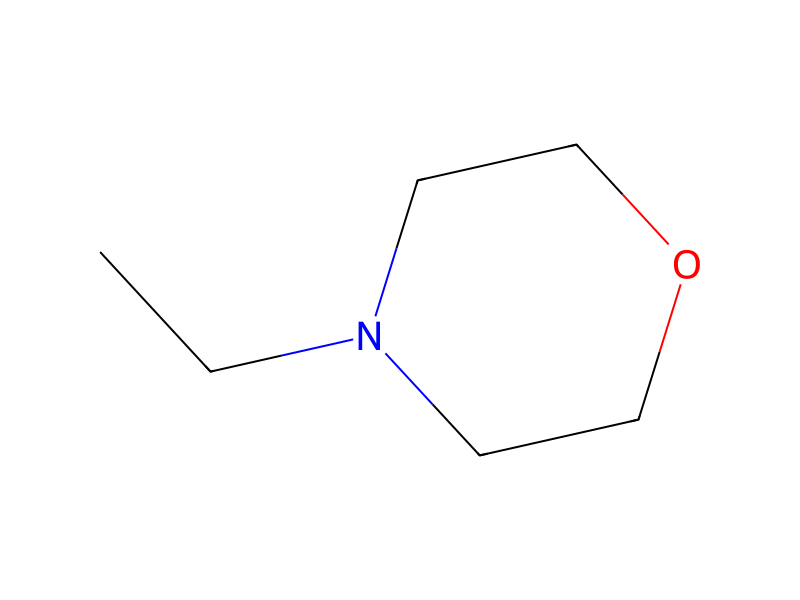




Procedure
Nε-dansyl-L-lysine (Sigma, 9.5 mg) was dissolved in 100 μl dimethylformamide under gentle warming. N-ethyl-morpholine (3 μl) was added, so that the apparent pH, as judged by spotting onto moist pH paper, was between 8 and 8.5. This solution was mixed with a solution of 7.3 mg of the hydroxysuccinimido ester of 4-carboxybenzaldehyde dimethylacetal in 50 μl dimethylformamide. The apparent pH was checked in the same way as before, and adjusted with N-ethylmorpholine (1 μl at a time) if necessary. After 4 hours and 30 minutes (the apparent pH having been checked from time to time and adjusted if necessary), a similar solution of 7.3 mg of the active ester was added and the reaction allowed to continue for a further 4 hours. The reaction, as judged by t.l.c., was then essentially complete. The t.l.c. system was that described in Example 1(c) and the Rf values were approx. 0.3 and 0.6 for dansyl-lysine and the product, respectively. The mixture was then diluted to 1 ml with acetic acid (1%. v/v), centrifuged, and the supernatant subjected to HPLC (system of Example 4(c)). The major fluorescent peak eluting on the gradient (around 40% acetonitrile) was pooled, and the acetonitrile was driven off in a current of air. The product was characterized by measurement of its electrophoretic mobility at pH 6.5 (predicted and observed, 0.5 [mAsp=1.0]). To this stock solution (600 μl) were added 6 μl M HCl, and the solution was diluted ten-fold with 10−3M HCl. This brought the concentration to 0.7 mM, as judged by direct comparison of the u.v. absorption spectrum with that of a solution of dansyl-lysine of known concentration. It was assumed that the optical density of the dansyl chromophore would be approximately the same in the two substances.
Workup
- custom30 minutes
- additionwas added
- waitto continue for a further 4 hours
- customThe reaction
- washThe major fluorescent peak eluting on the gradient (around 40% acetonitrile)
- additionTo this stock solution (600 μl) were added 6 μl M HCl
- additionthe solution was diluted ten-fold with 10−3M HCl
- concentrationthe concentration to 0.7 mM
- customabsorption spectrum with that
- concentrationof a solution of dansyl-lysine of known concentration
Sources & evidence
- ORD record
- ord-d3592f6f392943c388185dd14d66e33c
- Source dataset
- uspto-grants-2009_05
- Patent number
- US07538182B2
Reaction notes
Loading…