Phenylalanine ethyl ester → L-Phenylalanine
Reaction equation

C(O)(=O)C(C)O.[NH2:7][C@H:8]([C:16]([OH:18])=[O:17])[CH2:9][C:10]1[CH:15]=[CH:14][CH:13]=[CH:12][CH:11]=1.C(OC(=O)[C@H](CC1C=CC=CC=1)N)C>C(O)(C)C>[NH2:7][C@H:8]([C:16]([OH:18])=[O:17])[CH2:9][C:10]1[CH:15]=[CH:14][CH:13]=[CH:12][CH:11]=1Participants
Reactant 2


Product 1
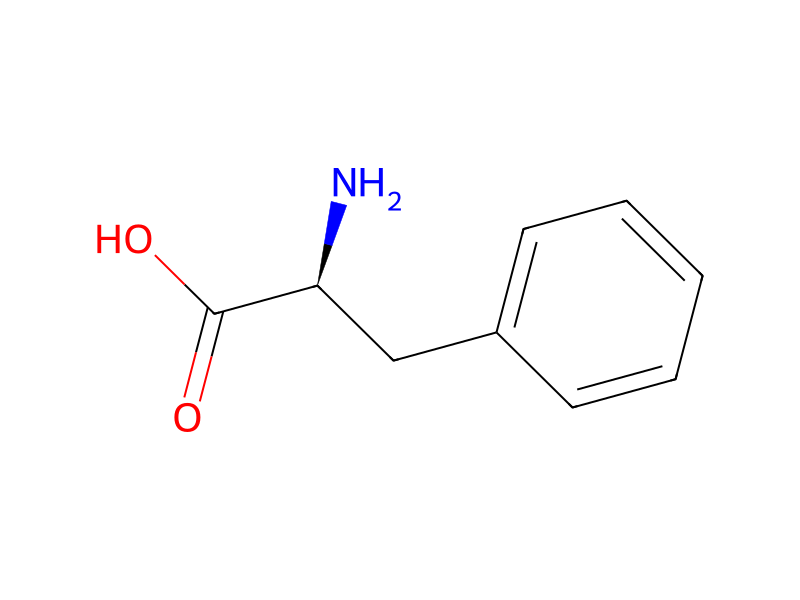
Reagents, catalysts & solvents 1

Procedure
The lactic acid was esterified with iso-propyl alcohol and was used along with the phenylalanine ethyl ester. An oligomerization yield of 80% was obtained with respect to phenylalanine. The positive and negative ion spectrum is provided in FIGS. 59A and 59B respectively. The positive ion spectrum reveals the strong presence of sodiated co-oligomers ions of NLA-(Phe)3-PheC-OEt+Na+ and NLA-(Phe)4-PheC-OEt+Na+ at masses 730 and 877 respectively. These peaks are separated by 147 units, which is the repeating residue unit of phenylalanine. The absence of any oligomer peaks is due to fact that the phenylaline does not oligomerize without a N-terminal starter molecule. This points to the presence of LA at the N-terminal end of the oligomer. The presence of ethyl ester (and absence of the iso-propyl ester) at the C-terminal end also reinforces this result. The negative ion spectrum reveals two sets of peaks with each set separated by 147 units. These sets represent the deprotonated co-oligomer peaks to form NLA-Phen-PheC-OEt with n having values of 3 and 4.
Sources & evidence
- ORD record
- ord-ac02a61fa991462a9cb95cc39340ae9a
- Source dataset
- uspto-grants-2005_09
- Patent number
- US06939693B2
Reaction notes
Loading…