1,4-Dioxane → Ketone, 3-furyl phenyl
Reaction equation

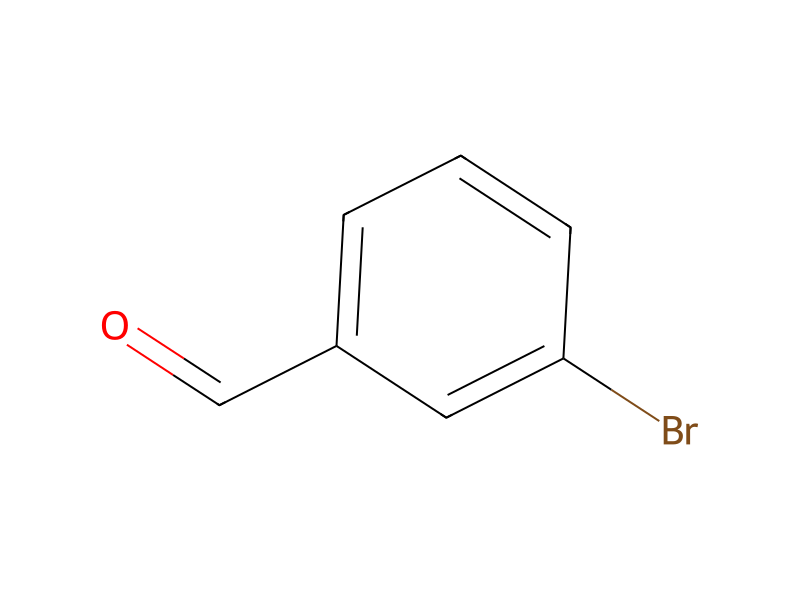
[O:1]1[CH2:6][CH2:5]O[CH2:3][CH2:2]1.Br[C:8]1[CH:9]=[C:10]([CH:13]=[CH:14][CH:15]=1)[CH:11]=[O:12].C([Sn](CCCC)(CCCC)C1OC=CC=1)CCC.[F-].[K+]>Cl[Pd](Cl)([P](C1C=CC=CC=1)(C1C=CC=CC=1)C1C=CC=CC=1)[P](C1C=CC=CC=1)(C1C=CC=CC=1)C1C=CC=CC=1.C(OCC)(=O)C>[O:1]1[CH:6]=[CH:5][CH:3]=[C:2]1[C:8]1[CH:9]=[C:10]([CH:13]=[CH:14][CH:15]=1)[CH:11]=[O:12]Participants
7






Procedure
EX-592A) To a dioxane (20 mL) solution of 3-bromobenzaldehyde (0.63 mL, 5.4 mmol) was added 2-(tributylstannyl)furan (1.89 mL, 6.00 mL) and Pd(PPh3)2Cl2 (0.21 g, 0.30 mmol). The mixture was heated to reflux under argon for 1.5 h. The cooled mixture was poured into a mixture of saturated KF and ethyl acetate and stirred 18 h. The slurry was filtered through celite. The organic layer was separated, washed with brine, dried (MgSO4) and evaporated to an oil. Purification by flash chromatography on silica gel eluting with 5% ethyl acetate in hexane gave 0.80 g (86%) of the desired 3-(2-furanyl)benzaldehyde product as an yellow oil which solidified upon standing. MS: m/z=173.1 [M+H]+.
Workup
- temperatureThe mixture was heated
- temperatureto reflux under argon for 1.5 h
- filtrationThe slurry was filtered through celite
- customThe organic layer was separated
- washwashed with brine
- dry with materialdried (MgSO4)
- customevaporated to an oil
- customPurification by flash chromatography on silica gel eluting with 5% ethyl acetate in hexane
Sources & evidence
- ORD record
- ord-c7218a36617a4189acd66a0662a36453
- Source dataset
- uspto-grants-2004_03
- Patent number
- US06710089B2
Reaction notes
Loading…