2,6-Lutidine → 3-(Tetrahydro-2-furanyl)phenylmethanol
Reaction equation
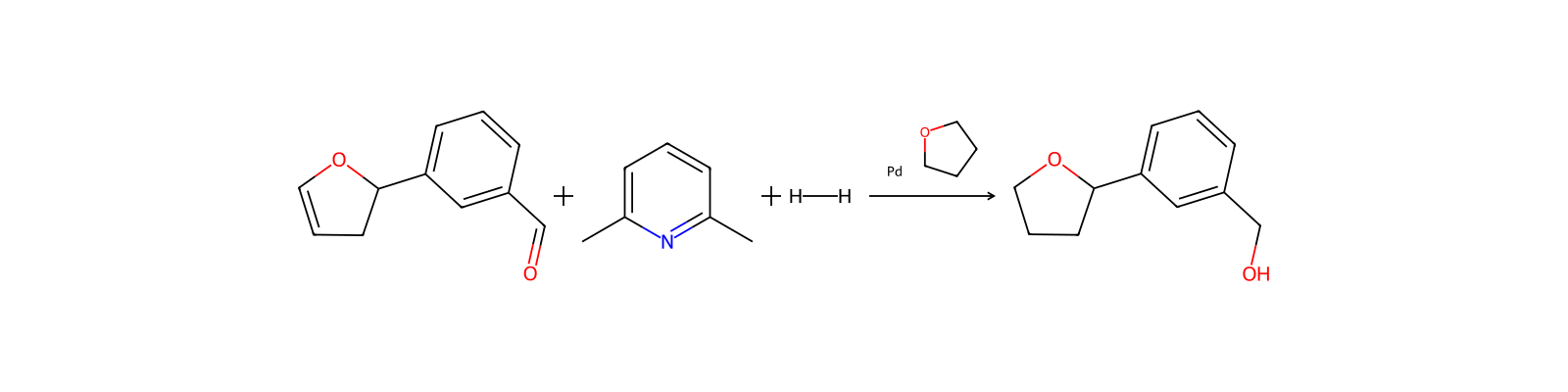
[O:1]1[CH:5]=[CH:4][CH2:3][CH:2]1[C:6]1[CH:7]=[C:8]([CH:11]=[CH:12][CH:13]=1)[CH:9]=[O:10].N1C(C)=CC=CC=1C.[H][H]>[Pd].C1COCC1>[O:1]1[CH2:5][CH2:4][CH2:3][CH:2]1[C:6]1[CH:7]=[C:8]([CH2:9][OH:10])[CH:11]=[CH:12][CH:13]=1Participants
6






Procedure
EX-608C) A THF (15 mL) solution of the aldehyde from EX-608B (0.70 g, 4.0 mmol) and 2,6-lutidine (0.46 mL, 4.0 mmol) was stirred in a hydrogen atmosphere (50 psi) in the presence of 10% Pd/C (0.29 g) for 18 h at room temperature. The slurry was filtered through celite, and the solvent was removed. The residue was taken up in ethyl acetate and washed with 1 N HCl and brine. The organic layer was dried (MgSO4) and evaporated to give 0.50 g (70%) of the desired 3-(tetrahydro-2-furanyl)phenylmethanol product as a yellow oil. The formation of the desired product was monitored by the disappearance of the aldehyde (δ˜10) and olefin peaks in the 1H NMR spectrum.
Workup
- filtrationThe slurry was filtered through celite
- customthe solvent was removed
- washwashed with 1 N HCl and brine
- dry with materialThe organic layer was dried (MgSO4)
- customevaporated
Sources & evidence
- ORD record
- ord-37160b998f8c4522b11d14f7a63b5a78
- Source dataset
- uspto-grants-2004_03
- Patent number
- US06710089B2
Reaction notes
Loading…