Diisopropylethylamine → HCID 59429657, compound
Reaction equation

[Cl:1][C:2]1[CH:10]=[C:9]2[C:5]([C:6]([C:12]([OH:14])=O)=[C:7]([CH3:11])[NH:8]2)=[CH:4][CH:3]=1.C(N(CC)C(C)C)(C)C.F[B-](F)(F)F.N1(OC(N(C)C)=[N+](C)C)C2C=CC=CC=2N=N1.[CH3:46][O:47][C:48]1[CH:53]=[CH:52][CH:51]=[CH:50][C:49]=1[CH:54]1[CH2:59][CH2:58][NH:57][CH2:56][CH2:55]1>CN(C)C=O>[Cl:1][C:2]1[CH:10]=[C:9]2[C:5]([C:6]([C:12]([N:57]3[CH2:58][CH2:59][CH:54]([C:49]4[CH:50]=[CH:51][CH:52]=[CH:53][C:48]=4[O:47][CH3:46])[CH2:55][CH2:56]3)=[O:14])=[C:7]([CH3:11])[NH:8]2)=[CH:4][CH:3]=1Participants
Reactant 4



Product 1

Reagents, catalysts & solvents 1

Procedure
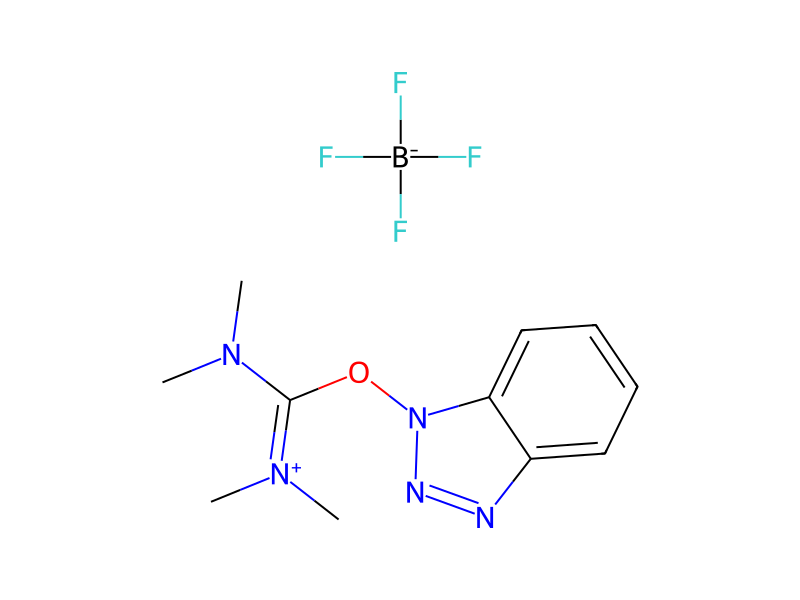
To a solution of 0.040 g (0.19 mmol) 6-chloro-2-methyl-1H-indole-3-carboxylic acid, 0.069 ml (0.40 mmol) N,N-diisopropylethylamine and 0.061 g (0.19 mmol) 2-(1H-benzotriazole-1-yl)-1,1,3,3-tetramethyluronium tetrafluoroborate in 1 ml dry N,N-dimethylformamide were added 0.038 g (0.20 mmol) 4-(2-methoxy-phenyl)-piperidine at room temperature. After stirring for 1 h the reaction mixture was quenched with 0.5 M aqueous sodium hydroxide solution (20 ml) and extracted with ethyl acetate (2×30 ml). The combined organic layers were washed with water (2×30 ml) and brine (1×30 ml), dried over sodium sulfate and concentrated in vacuo. The residue was purified by flash chromatography (n-heptane/ethyl acetate) to give the title compound (0.050 g; 69%) as a white solid.
Workup
- customwas quenched with 0.5 M aqueous sodium hydroxide solution (20 ml)
- extractionextracted with ethyl acetate (2×30 ml)
- washThe combined organic layers were washed with water (2×30 ml) and brine (1×30 ml)
- dry with materialdried over sodium sulfate
- concentrationconcentrated in vacuo
- customThe residue was purified by flash chromatography (n-heptane/ethyl acetate)
Sources & evidence
- ORD record
- ord-906cf2c8301c4b169bfa0ba6f6370d40
- Source dataset
- uspto-grants-2010_08
- Patent number
- US07781436B2
Reaction notes
Loading…