Water → HCID 44218770, compound
Reaction equation

[Cl:1][C:2]1[CH:19]=[CH:18][C:5]([CH2:6][S:7][C:8]2[C:9](=[O:17])[N:10]([CH2:14][CH2:15][CH3:16])[CH:11]=[CH:12][N:13]=2)=[CH:4][CH:3]=1.[Na].[OH:21]OS([O-])=O.[K+].[OH2:27]>O1CCCC1>[Cl:1][C:2]1[CH:19]=[CH:18][C:5]([CH2:6][S:7]([C:8]2[C:9](=[O:17])[N:10]([CH2:14][CH2:15][CH3:16])[CH:11]=[CH:12][N:13]=2)(=[O:21])=[O:27])=[CH:4][CH:3]=1Participants
6
Reactant 4


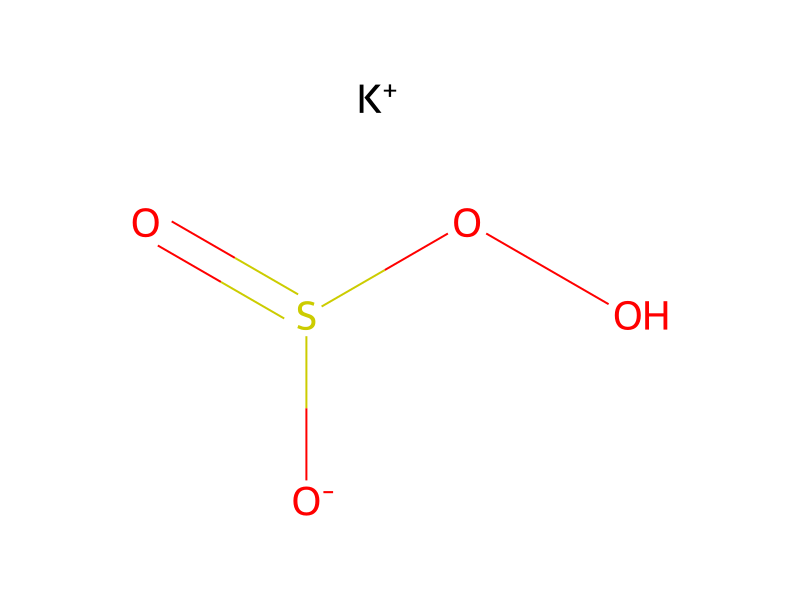

Product 1

Reagents, catalysts & solvents 1

Procedure
To 360 mg (1.17 mM) of 3-[(4-chlorobenzyl)thio]-1-propylpyrazin-2(1H)-one and 107.7 mg (1.28 mM) of sodium hydrogenocarbonate in 2 ml of tetrahydrofurane were added 2.9 g (4.7 mM) of oxone in 2 ml of water. The reaction mixture was stirred for 3 h at room temperature. Water was added and the aqueous layer was extracted with ethyle acetate. The organic layer was separated and washed with water, dried on anhydrous sodium sulfate and evaporated under vacuum. The residue was taken up in diisopropyle oxide, filtered and washed with diisopropyle oxide, to give 90 mg of 3-[(4-chlorobenzyl)sulfonyl]-1-propylpyrazin-2(1H)-one. Yield: 23%.
Workup
- extractionthe aqueous layer was extracted with ethyle acetate
- customThe organic layer was separated
- washwashed with water
- dry with materialdried on anhydrous sodium sulfate
- customevaporated under vacuum
- filtrationfiltered
- washwashed with diisopropyle oxide
Sources & evidence
- ORD record
- ord-9d9a4636a80a46dbaaa2882d0e0d5dbb
- Source dataset
- uspto-grants-2015_08
- Patent number
- US09102632B2
Reaction notes
Loading…