Potassium Carbonate → 2-Chloro-5-fluoro-4-(4-fluoro-2-methoxyphenyl)pyrimidine
Reaction equation

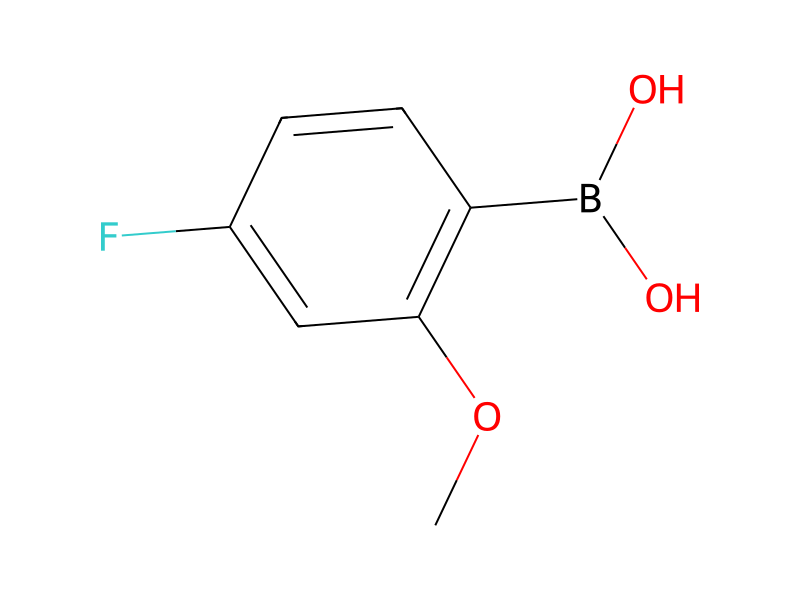
[Cl:1][C:2]1[N:7]=[C:6](Cl)[C:5]([F:9])=[CH:4][N:3]=1.[F:10][C:11]1[CH:16]=[CH:15][C:14](B(O)O)=[C:13]([O:20][CH3:21])[CH:12]=1.C(=O)([O-])[O-].[K+].[K+]>COCCOC.C(OCC)(=O)C>[Cl:1][C:2]1[N:7]=[C:6]([C:14]2[CH:15]=[CH:16][C:11]([F:10])=[CH:12][C:13]=2[O:20][CH3:21])[C:5]([F:9])=[CH:4][N:3]=1Participants
6
Reactant 3


Product 1

Reagents, catalysts & solvents 2


Conditions
- Temperature
- 90 °C
Procedure
A batch with 2,4-dichloro-5-fluoropyrimidine (200 mg; 1.20 mmol; Aldrich Chemical Company Inc.), (4-fluoro-2-methoxyphenyl)boronic acid (224 mg; 1.31 mmol; Aldrich Chemical Company Inc.) and tetrakis(triphenylphosphin)palladium(0) (138 mg; 0.12 mmol) in 1,2-dimethoxyethane (3.6 mL) and 2 M solution of potassium carbonate (1.8 mL) was degassed using argon. The batch was stirred under argon for 16 hours at 90° C. After cooling the batch was diluted with ethyl acetate and washed with brine. The organic phase was filtered using a Whatman filter and concentrated. The residue was purified by column chromatography (hexane/ethyl acetate 1:1) to give the desired product (106 mg; 0.41 mmol).
Workup
- temperatureAfter cooling the batch
- washwashed with brine
- filtrationThe organic phase was filtered
- filtrationfilter
- concentrationconcentrated
- customThe residue was purified by column chromatography (hexane/ethyl acetate 1:1)
Sources & evidence
- ORD record
- ord-a108dd59e26c4818bc4f2100fee1e294
- Source dataset
- uspto-grants-2015_08
- Patent number
- US09108926B2
Reaction notes
Loading…