Triphenylphosphine → 1,4-Dihydrocinnoline
Reaction equation
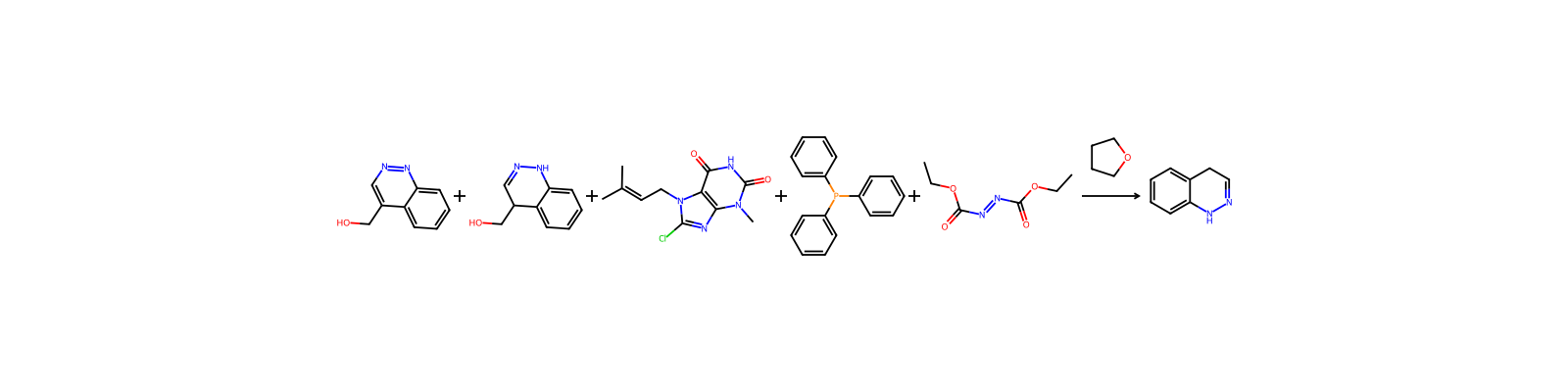
[N:1]1[C:10]2[C:5](=[CH:6][CH:7]=[CH:8][CH:9]=2)[C:4](CO)=[CH:3][N:2]=1.N1C2C(=CC=CC=2)C(CO)C=N1.CN1C2N=C(Cl)N(CC=C(C)C)C=2C(=O)NC1=O.C1(P(C2C=CC=CC=2)C2C=CC=CC=2)C=CC=CC=1.N(C(OCC)=O)=NC(OCC)=O>O1CCCC1>[NH:1]1[C:10]2[C:5](=[CH:6][CH:7]=[CH:8][CH:9]=2)[CH2:4][CH:3]=[N:2]1Participants
7
Reactant 5




Product 1

Reagents, catalysts & solvents 1

Procedure
510 mg of a mixture of (cinnolin-4-yl)-methanol and (1,4-dihydro-cinnolin-4-yl)-methanol (see Ex. XXVII) are added to 830 mg of 3-methyl-7-(3-methyl-2-buten-1-yl)-8-chloro-xanthine and 1.25 g of triphenylphosphine in 25 ml of tetrahydrofuran. The reaction mixture is combined with 0.92 ml diethyl azodicarboxylate and stirred overnight at ambient temperature. Then it is evaporated down and chromatographed through a silica gel column with ethyl acetate/petroleum ether (7:3 to 0:1) as eluant. A mixture of cinnoline and 1,4-dihydro-cinnoline compound is obtained.
Workup
- customThen it is evaporated down
- customchromatographed through a silica gel column with ethyl acetate/petroleum ether (7:3 to 0:1) as eluant
- additionA mixture of cinnoline
Sources & evidence
- ORD record
- ord-bcf2d3dd1cc4428581051e86f73922cc
- Source dataset
- uspto-grants-2015_08
- Patent number
- US09108964B2
Reaction notes
Loading…