4-Vinylbenzaldehyde → N1-(4-vinylbenzyl)-N6-(2,2-diethoxyethyl)hexane-1,6-diamine
Reaction equation

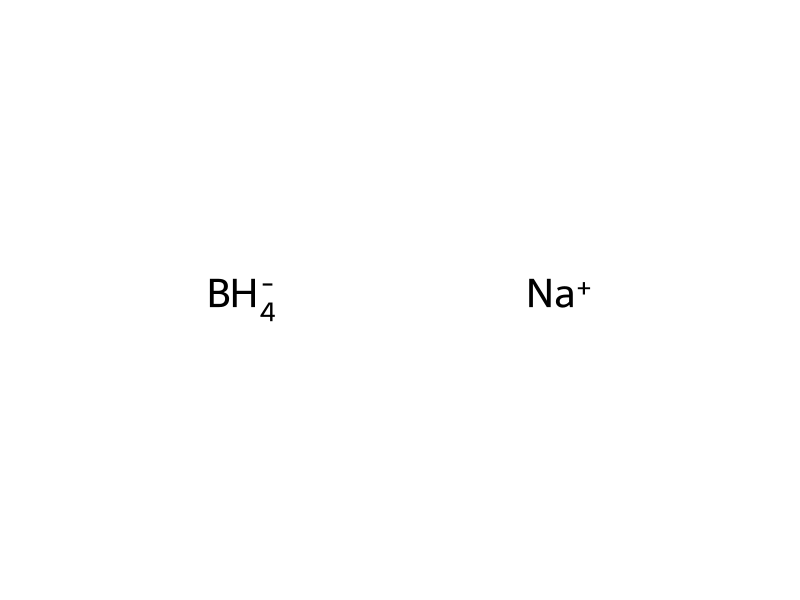
[CH:1]([C:3]1[CH:10]=[CH:9][C:6]([CH:7]=[CH2:8])=[CH:5][CH:4]=1)=O.[CH2:11]([O:13][CH:14]([O:24][CH2:25][CH3:26])[CH2:15][NH:16][CH2:17][CH2:18][CH2:19][CH2:20][CH2:21][CH2:22][NH2:23])[CH3:12].[BH4-].[Na+]>C(Cl)Cl.C(O)C.O>[CH:7]([C:6]1[CH:9]=[CH:10][C:3]([CH2:1][NH:23][CH2:22][CH2:21][CH2:20][CH2:19][CH2:18][CH2:17][NH:16][CH2:15][CH:14]([O:13][CH2:11][CH3:12])[O:24][CH2:25][CH3:26])=[CH:4][CH:5]=1)=[CH2:8]Participants
Reactant 3


Product 1

Reagents, catalysts & solvents 3
Procedure
4-Formylstyrene, 1c (2.98 g, 22.5 mmol) and 2c (5.00 g, 21.5 mmol) were weighed into a 250 mL 3-neck RB flask and ethanol (90 mL) added forming a colourless solution. The flask was then attached to two B19 stoppers (side-arms) and a B24 double-layer coil condenser (centre-socket) and this in turn connected to a nitrogen-vacuum manifold. The apparatus was flushed with nitrogen and the reaction mixture stirred overnight at room temperature. Next day 3-(diethylenetriamino)propyl-functionalised silica gel (1.85 g, 1.23 mmol/g loading) was added to the reaction mixture which was stirred at room temperature under nitrogen for a period of 6 hours in order to scavenge the excess 4-formylstyrene. Sodium borohydride (1.22 g, 32.2 mmol) was then added to the reaction mixture which was then stirred at room temperature for a period of 65 hours under nitrogen. Water (100 mL) was then added to the reaction mixture via syringe in order to quench the reaction. The reaction mixture was then stirred for 30 minutes at room temperature before the ethanol was stripped from the mixture in vacuo using a rotary evaporator to yield a white emulsion. CH2Cl2 (100 mL) was added to this residue and the resultant mixture transferred to a 250 mL-separating funnel. Water (10 mL) was added to the funnel which was then shaken and the layers partitioned and the lower organic layer decanted off. The aqueous layer was discarded and the organic layer then extracted with a further 2×100 mL portions of brine. The layers were partitioned and the lower organic layer collected and dried over anhydrous MgSO4 for a period of 1 hour. The drying mixture was filtered and the collected solid washed with 3×20 mL portions of CH2Cl2. The filtrate and washings were combined and stripped to dryness in vacuo using a rotary evaporator for a period of 1 hour to yield a very pale yellow oil. This was then further dried in vacuo (0.25 torr) at room temperature for a period of 20 hours. Yield: 6.82 g (91%, pale yellow oil). NMR (CDCl3) δ 1.21 (t, 6H, —CH3), 1.32 (bm, 4H, —CH2—), 1.48 (bm, 4H, —CH2—), 2.61 (triplet of doublets, 4H, hexamethylene bridge >NCH2—), 2.71 (d, 2H, 2,2-diethoxyethyl NCH2—), 3.54 (m, 2H, HA of OC(HA)(HB)—), 3.69 (m, 2H, HB of OC(HA)(HB)—), 3.76 (s, 2H, >NCH2Ar), 4.59 (t, 1H, —CH(OR)2), 5.20 (d, 1H, ═C—H), 5.72 (d, 1H, ═C—H), 6.70 (dd, 1H, ═C—H), 7.26 (d, 2H, ArH), 7.36 (d, 2H, ArH).
Workup
- additionadded
- customforming a colourless solution
- customThe apparatus was flushed with nitrogen
- additionNext day 3-(diethylenetriamino)propyl-functionalised silica gel (1.85 g, 1.23 mmol/g loading) was added to the reaction mixture which
- stirringwas stirred at room temperature under nitrogen for a period of 6 hours in order
- stirringwas then stirred at room temperature for a period of 65 hours under nitrogen
- customto quench
- customthe reaction
- customa rotary evaporator
- customto yield a white emulsion
- customseparating funnel
- additionWater (10 mL) was added to the funnel which
- stirringwas then shaken
- customthe layers partitioned
- customthe lower organic layer decanted off
- extractionthe organic layer then extracted with a further 2×100 mL portions of brine
- customThe layers were partitioned
- customthe lower organic layer collected
- dry with materialdried over anhydrous MgSO4 for a period of 1 hour
- filtrationThe drying mixture was filtered
- washthe collected solid washed with 3×20 mL portions of CH2Cl2
- customa rotary evaporator for a period of 1 hour
- customto yield a very pale yellow oil
- customThis was then further dried in vacuo (0.25 torr) at room temperature for a period of 20 hours
Sources & evidence
- ORD record
- ord-867714040b4d424195286ca3ce397fbb
- Source dataset
- uspto-grants-2015_08
- Patent number
- US09115063B2
Reaction notes
Loading…