Trifluoroacetic acid → 4-(Morpholinomethyl)thiazol-2-amine trifluoroacetate
Reaction equation
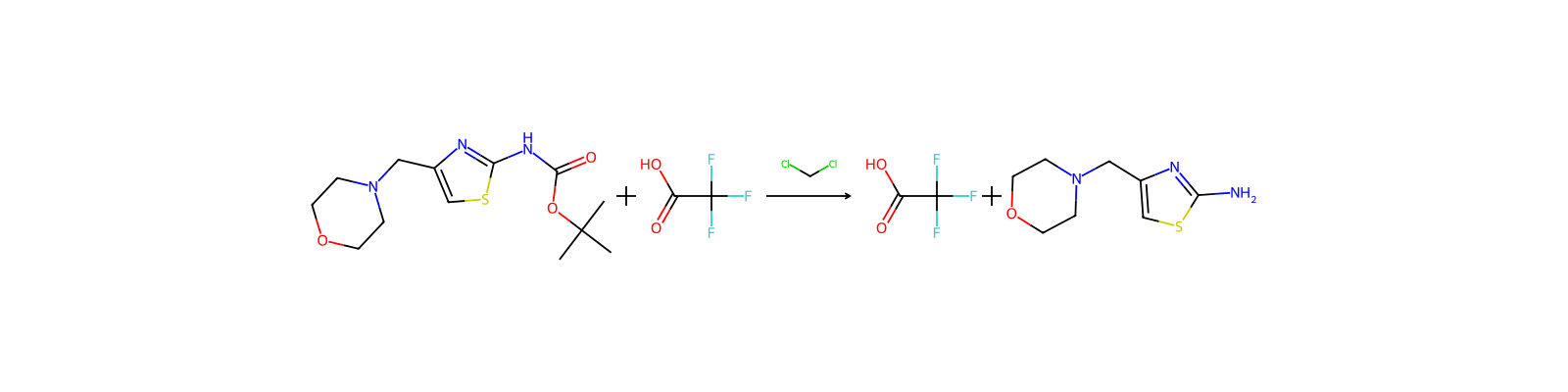
[O:1]1[CH2:6][CH2:5][N:4]([CH2:7][C:8]2[N:9]=[C:10]([NH:13]C(=O)OC(C)(C)C)[S:11][CH:12]=2)[CH2:3][CH2:2]1.[F:21][C:22]([F:27])([F:26])[C:23]([OH:25])=[O:24]>C(Cl)Cl>[F:21][C:22]([F:27])([F:26])[C:23]([OH:25])=[O:24].[O:1]1[CH2:6][CH2:5][N:4]([CH2:7][C:8]2[N:9]=[C:10]([NH2:13])[S:11][CH:12]=2)[CH2:3][CH2:2]1Participants
4
Reactant 2


Product 1

Reagents, catalysts & solvents 1

Procedure
Tert-butyl 4-(morpholinomethyl)thiazol-2-ylcarbamate 90 (1.88 g, 6.28 mmol) was treated with 20 mL of 25% trifluoroacetic acid in CH2Cl2 for 18 h at room temperature. After all the solvent had been removed by concentrating and drying under high vacuum, the resulting residue was treated with a mixture of pentane/EtOAc to afford 91 (1.96 g, 100% yield) as a white solid.
Workup
- customAfter all the solvent had been removed
- concentrationby concentrating
- customdrying under high vacuum
- additionthe resulting residue was treated with a mixture of pentane/EtOAc
Sources & evidence
- ORD record
- ord-7b49e0f97b4b4b0fb5a69cde5d0a513a
- Source dataset
- uspto-grants-2016_05
- Patent number
- US09326986B2
Reaction notes
Loading…