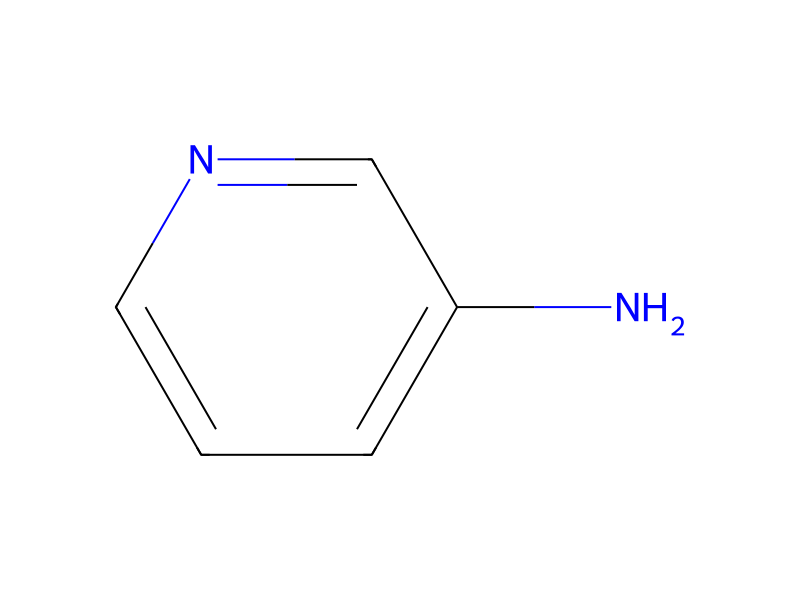
3-Aminopyridine → 6-bromo-2-hydroxy-N-(pyridin-3-yl)quinoline-4-carboxamide
Reaction equation

[Br:1][C:2]1[CH:3]=[C:4]2[C:9](=[CH:10][CH:11]=1)[N:8]=[C:7]([OH:12])[CH:6]=[C:5]2[C:13]([OH:15])=O.[NH2:16][C:17]1[CH:18]=[N:19][CH:20]=[CH:21][CH:22]=1.C(P1(=O)OP(CCC)(=O)OP(CCC)(=O)O1)CC.CCN(C(C)C)C(C)C>ClCCl>[Br:1][C:2]1[CH:3]=[C:4]2[C:9](=[CH:10][CH:11]=1)[N:8]=[C:7]([OH:12])[CH:6]=[C:5]2[C:13]([NH:16][C:17]1[CH:18]=[N:19][CH:20]=[CH:21][CH:22]=1)=[O:15]Participants
6




Conditions
- Temperature
- 0 °C
Procedure
A solution of 6-bromo-2-hydroxyquinoline-4-carboxylic acid (9.0 g) was dissolved in dichloromethane and cooled to 0° C. 3-aminopyridine (1 eq), T3P (2,4,6-tripropyl-1,3,5,2,4,6-trioxatriphosphinane 2,4,6-trioxide, 50% solution in ethyl acetate, 1.2 eq.), and DIPEA (diisopropylethylamine, 2.0 eq) were added. The solution was stirred at 0° C. for 30 minutes and then allowed to warm to room temperature overnight. The solution was washed with water, sat. sodium chloride, dried, and concentrated. Purification by silica gel column chromatography provided 6-bromo-2-hydroxy-N-(pyridin-3-yl)quinoline-4-carboxamide (9.0 g).
Workup
- temperatureto warm to room temperature overnight
- washThe solution was washed with water, sat. sodium chloride
- customdried
- concentrationconcentrated
- customPurification by silica gel column chromatography
Sources & evidence
- ORD record
- ord-977a796899514b2685cc56568cfd7e7e
- Source dataset
- uspto-grants-2016_05
- Patent number
- US09345700B2
Reaction notes
Loading…