4-Methylmorpholine → 2-Isopropyl-4-(p-nitrophenyloxycarbonyloxymethyl)thiazole
Reaction equation

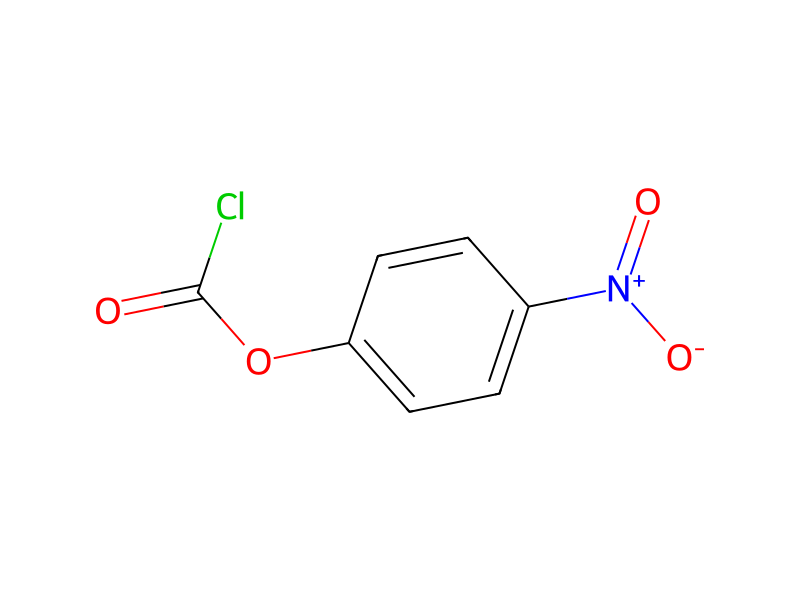
Cl[C:2]([O:4][C:5]1[CH:10]=[CH:9][C:8]([N+:11]([O-:13])=[O:12])=[CH:7][CH:6]=1)=[O:3].[OH:14][CH2:15][C:16]1[N:17]=[C:18]([CH:21]([CH3:23])[CH3:22])[S:19][CH:20]=1.CN1CCOCC1>C(Cl)Cl>[CH:21]([C:18]1[S:19][CH:20]=[C:16]([CH2:15][O:14][C:2]([O:4][C:5]2[CH:6]=[CH:7][C:8]([N+:11]([O-:13])=[O:12])=[CH:9][CH:10]=2)=[O:3])[N:17]=1)([CH3:23])[CH3:22]Participants




Conditions
- Temperature
- 0 °C
Procedure
A solution of 1.12 g (5.56 mmol) of 4-nitrophenyl chloroformate in 20 ml of CH2Cl2 was cooled to 0° C. and treated sequentially with 0.8 g (5.1 mmol) of 4-(hydroxymethyl)-2-isopropylthiazole and 0.6 ml (5.6 mmol) of 4-methylmorpholine. The resulting solution was stirred at 0° C. for 1 h, diluted with CH2Cl2, washed with three portions of aqueous NaHCO3, dried over Na2SO4, and concentrated in vacuo to give crude 2-isopropyl-4-(p-nitrophenyloxycarbonyloxymethyl)thiazole. A portion (0.53 g, 1.65 mmol) of the residue was taken up in 20 ml of chloroform, treated with 0.23 g (1.67 mmol) of L-alanine methyl ester hydrochloride and 0.36 ml (3.3 mmol) of 4-methylmorpholine, and heated at reflux for 16 h. After being allowed to cool, the solvent was removed in vacuo, and the residue was purified by silica gel chromatography using 2% methanol in chloroform to provide 0.45 g (94%) of the desired compound, Rf 0.43 (5% methanol in CH2Cl2). 1H NMR (DMSO-d6) δ1.26 (d, J=8 Hz, 3H), 1.32 (d, J=7 Hz, 6H), 3.27 (heptet, J=7 Hz, 1H), 3.63 (s, 3H), 4.10 (p, J=8 Hz, 1H), 5.02 (s, 2H), 7.47 (s, 1H), 7.81 (d, J=8 Hz, 1H). Mass spectrum: (M+H)+ =287.
Workup
- washwashed with three portions of aqueous NaHCO3
- dry with materialdried over Na2SO4
- concentrationconcentrated in vacuo
Sources & evidence
- ORD record
- ord-b72f46093b19443f8fa1c0c987877919
- Source dataset
- uspto-grants-1997_04
- Patent number
- US05616720
Reaction notes
Loading…