Hydrazine hydrate (1:1) → HCID 86701913, compound
Reaction equation

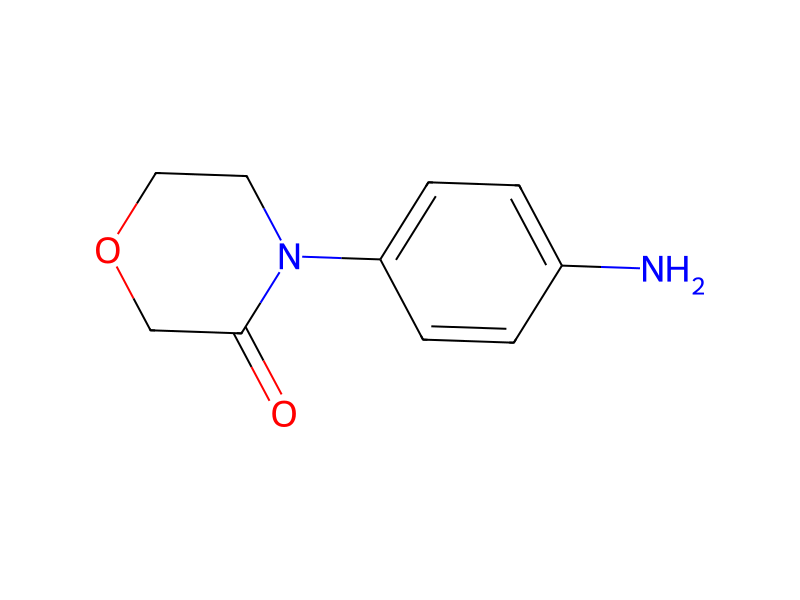
[C:1]([C:3](=[C:7](SC)SC)[C:4]([NH2:6])=[O:5])#[N:2].[NH2:12][C:13]1[CH:18]=[CH:17][C:16]([N:19]2[CH2:24][CH2:23][O:22][CH2:21][C:20]2=O)=[CH:15][CH:14]=1.[OH2:26].[NH2:27][NH2:28]>CCO>[NH2:2][C:1]1[NH:28][N:27]=[C:7]([NH:12][C:13]2[CH:18]=[CH:17][C:16]([N:19]3[CH2:24][CH2:23][O:22][C:21](=[O:26])[CH2:20]3)=[CH:15][CH:14]=2)[C:3]=1[C:4]([NH2:6])=[O:5]Participants
Reactant 3


Product 1

Reagents, catalysts & solvents 1

Conditions
- Temperature
- 75 °C
Procedure
Dissolved 0.500 g 2-cyano-3,3-bis(methylthio)acrylamide in 15 mL EtOH and added 4-(4-aminophenyl)morpholin-3-one (1.0 eq.). Stirred reaction at 75° C. until starting amide was absent by HPLC. Once complete (18 hrs), reaction was brought to room temperature and filtered to obtain a light yellow powder as product. Product was allowed to dry under vacuum for 1 hr. Product was then suspended in 10 mL EtOH and hydrazine hydrate (1 eq.) was added dropwise. Reaction was heated at 75° C. until intermediate was absent (HPLC). Once intermediate was absent (18 hrs), reaction was brought to room temperature and filtered to obtain 5-amino-3-((4-(2-oxomorpholino)phenyl)amino)-1H-pyrazole-4-carboxamide as a yellow powder. Product was allowed to dry under vacuum for 1 hr.
Workup
- customreaction at 75° C.
- customOnce complete (18 hrs), reaction
- customwas brought to room temperature
- filtrationfiltered
- customto obtain a light yellow powder as product
- customto dry under vacuum for 1 hr
- customReaction
- custom(18 hrs), reaction
- customwas brought to room temperature
- filtrationfiltered
Sources & evidence
- ORD record
- ord-ea790efa1ff74305bad09406c4a1bfcc
- Source dataset
- uspto-grants-2016_05
- Patent number
- US09346792B2
Reaction notes
Loading…