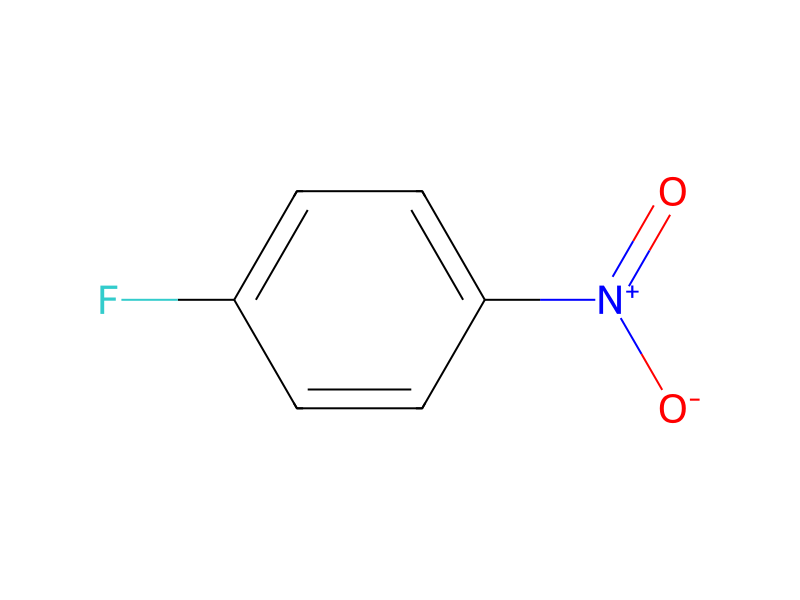
p-Fluoronitrobenzene → HCID 67960136, compound
Reaction equation

C(=O)([O-])[O-].[K+].[K+].[CH2:7]1[C:11]2[CH:12]=[CH:13][CH:14]=[C:15]([OH:16])[C:10]=2[CH2:9][O:8]1.F[C:18]1[CH:23]=[CH:22][C:21]([N+:24]([O-:26])=[O:25])=[CH:20][CH:19]=1>CN(C)C=O>[N+:24]([C:21]1[CH:22]=[CH:23][C:18]([O:16][C:15]2[C:10]3[CH2:9][O:8][CH2:7][C:11]=3[CH:12]=[CH:13][CH:14]=2)=[CH:19][CH:20]=1)([O-:26])=[O:25]Participants
5
Reactant 3


Product 1

Reagents, catalysts & solvents 1

Conditions
- Temperature
- 100 °C
Procedure
A suspension of potassium carbonate (670 mg, 4.85 mmol), 1,3-dihydro-2-benzofuran-4-ol (Intermediate 2, 110 mg) and 1-fluoro-4-nitrobenzene (114 mg, 0.808 mmol) in N,N-dimethylformamide (DMF) (5 ml) was heated under microwave irradiation at 100° C. for 3×30 minutes. The mixture was concentrated. 2 ml of water were added and then dichloromethane. The phases were separated and the aqueous phase was extracted twice with dichloromethane. The organic phase was dried over sodium sulphate and concentrated under vacuum to afford the title compound, which was directly used in the next step.
Workup
- concentrationThe mixture was concentrated
- addition2 ml of water were added
- customThe phases were separated
- extractionthe aqueous phase was extracted twice with dichloromethane
- dry with materialThe organic phase was dried over sodium sulphate
- concentrationconcentrated under vacuum
Sources & evidence
- ORD record
- ord-9e8458815d5549d894145acec3e77f8a
- Source dataset
- uspto-grants-2016_05
- Patent number
- US09346790B2
Reaction notes
Loading…