(4-Aminophenyl)arsonic acid → [4-(2-Bromoacetamido)phenyl]arsonic acid
Reaction equation

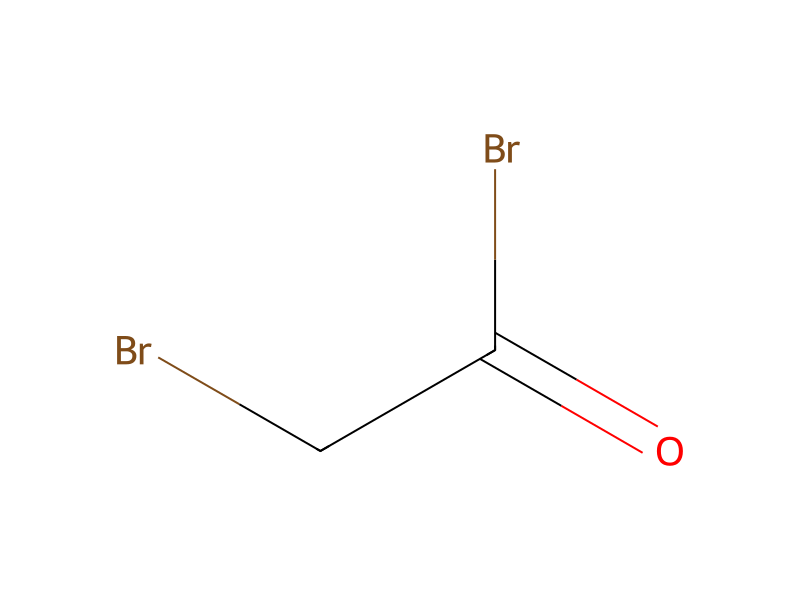
[CH:1]1[C:6]([NH2:7])=[CH:5][CH:4]=[C:3]([As:8]([OH:11])([OH:10])=[O:9])[CH:2]=1.C(=O)([O-])[O-].[Na+].[Na+].[Br:18][CH2:19][C:20](Br)=[O:21]>O.ClCCl>[Br:18][CH2:19][C:20]([NH:7][C:6]1[CH:1]=[CH:2][C:3]([As:8]([OH:10])(=[O:11])[OH:9])=[CH:4][CH:5]=1)=[O:21]Participants
Reactant 3


Product 1

Reagents, catalysts & solvents 2


Conditions
- Temperature
- 4 °C
Procedure
BRAA was prepared by a modification of the method described in Donoghue et al (2000) and WO 01/21628. p-Arsanilic acid (20.6 g, 95 mmol) was added in portions to a solution of sodium carbonate (20 g, 189 mmol) in water (200 mL). When all solids had dissolved, the solution was found to be pH 10, and was chilled at 4° C. for 2 hours. Bromoacetyl bromide (15 mL, 173 mmol) in dry dichloromethane (35 mL) was added in two portions, each addition followed by vigorous shaking for 2 to 3 min. The mixture was allowed to stand for a few minutes, and the lower organic layer was drained off. 4-(N-(Bromoacetyl)amino)benzenearsonic acid (BRAA) was precipitated by acidification of the solution to about pH 2-3 with the dropwise addition of 98% sulfuric acid, collected by vacuum filtration, and dried, giving BRAA as a white solid.
Workup
- customBRAA was prepared by a modification of the method
- dissolutionWhen all solids had dissolved
- additioneach addition
- waitto stand for a few minutes
- custom4-(N-(Bromoacetyl)amino)benzenearsonic acid (BRAA) was precipitated by acidification of the solution to about pH 2-3 with the dropwise addition of 98% sulfuric acid
- filtrationcollected by vacuum filtration
- customdried
Sources & evidence
- ORD record
- ord-3a8edfe38fa24a65b482489fe5117ed2
- Source dataset
- uspto-grants-2016_05
- Patent number
- US09353152B2
Reaction notes
Loading…