Hydrochloric Acid → 2-Pyridinecarboxylic acid, 4,5-dichloro-6-(4-chloro-2-fluoro-3-methoxyphenyl)-
Reaction equation

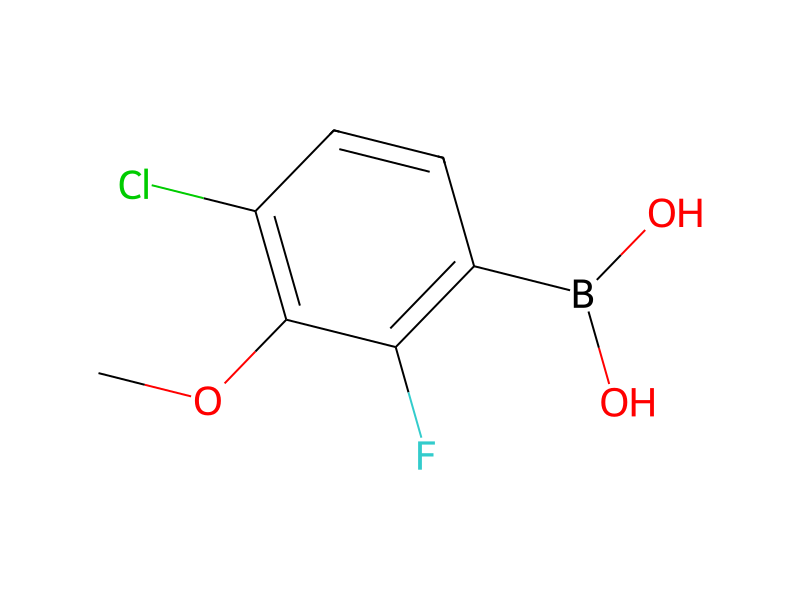
[Cl:1][C:2]1[C:7]([Cl:8])=[C:6](Cl)[N:5]=[C:4]([C:10]([OH:12])=[O:11])[CH:3]=1.C(N(CC)CC)C.[Cl:20][C:21]1[CH:26]=[CH:25][C:24](B(O)O)=[C:23]([F:30])[C:22]=1[O:31][CH3:32].Cl>C(#N)C.Cl[Pd](Cl)([P](C1C=CC=CC=1)(C1C=CC=CC=1)C1C=CC=CC=1)[P](C1C=CC=CC=1)(C1C=CC=CC=1)C1C=CC=CC=1.O>[Cl:1][C:2]1[C:7]([Cl:8])=[C:6]([C:24]2[CH:25]=[CH:26][C:21]([Cl:20])=[C:22]([O:31][CH3:32])[C:23]=2[F:30])[N:5]=[C:4]([C:10]([OH:12])=[O:11])[CH:3]=1Participants
Reactant 4



Product 1

Reagents, catalysts & solvents 3



Conditions
- Temperature
- 50 °C
Procedure
To a 50 mL three-necked flask equipped with a stirring bar and a condenser were placed 4,5,6-trichloropicolinic acid (0.503 g, 90% purity, 2 mmol), triethylamine (0.607, 6 mmol), acetonitrile (5 g) and water (5 g). The mixture became a homogeneous solution which was sparged with nitrogen for 15 minutes. Bis(triphenylphosphine)palladium(II) dichloride (0.042 g, 0.06 mmol) was added and the mixture was heated to 50° C. In a one-necked flask were placed (4-chloro-2-fluoro-3-methoxyphenyl)-boronic acid (1.951 g, 22 wt % in methyl isobutyl ketone/dimethoxyethane, 2.1 mmol) and acetonitrile (2.5 g). The solution was sparged with nitrogen for 15 minutes, and then slowly added to trichloropicolinic acid solution by a syringe pump at 50° C. The total addition time was about two hours. The reaction mixture was stirred at 50° C. for three more hours. A sample was taken and analyzed by HPLC. The LC results indicated that the reaction was completed. The reaction mixture was allowed to cool to room temperature. To acidify the reaction mixture, hydrochloric acid (6 g, 1 N HCl in water) was added to the flask dropwise. The resulting slurry was stirred overnight. The mixture was filtered and a light brown solid was obtained. This crude product was stirred in acetonitrile at room temperature for 2 hours. After filtration and vacuum drying, the white product (0.44 g, 92% LC purity, 58% yield) was obtained. 1H NMR (400 MHz, THF-d8) δ 8.35 (s, 1H), 7.40 (dd, J=8.5, 1.7 Hz, 1H), 7.23 (dd, J=8.5, 6.9 Hz, 1H), 4.00 (d, J=1.3 Hz, 3H); 13C NMR (101 MHz, THF-d8) δ 163.62 (s), 154.81 (s), 153.03 (s), 152.31 (s), 147.36 (s), 144.64 (d, J=13.4 Hz), 143.70 (s), 133.21 (s), 129.55 (d, J=3.5 Hz), 126.34 (d, J=14.4 Hz), 125.71 (s), 125.41-125.01 (m), 60.91 (d, J=4.8 Hz); 19F NMR (376 MHz, THF-d8) δ+−128.96. ESI/LC/MS/PI (M+H)+=349.9559 (100%), 351.9531 (99.66%), 353.95 (33.59%).
Workup
- customTo a 50 mL three-necked flask equipped with a stirring bar and a condenser
- customwas sparged with nitrogen for 15 minutes
- customIn a one-necked flask were placed
- customThe solution was sparged with nitrogen for 15 minutes
- additionslowly added to trichloropicolinic acid solution by a syringe pump at 50° C
- additionThe total addition time
- customThe LC results
- temperatureto cool to room temperature
- additionwas added to the flask dropwise
- stirringThe resulting slurry was stirred overnight
- filtrationThe mixture was filtered
- customa light brown solid was obtained
- filtrationAfter filtration and vacuum
- customdrying
- customthe white product (0.44 g, 92% LC purity, 58% yield) was obtained
Sources & evidence
- ORD record
- ord-2b6dea0e5a3d4a7bafb46fa7509caf63
- Source dataset
- uspto-grants-2014_10
- Patent number
- US08871943B2
Reaction notes
Loading…