Acetyl chloride → HCID 67285454, compound
Reaction equation
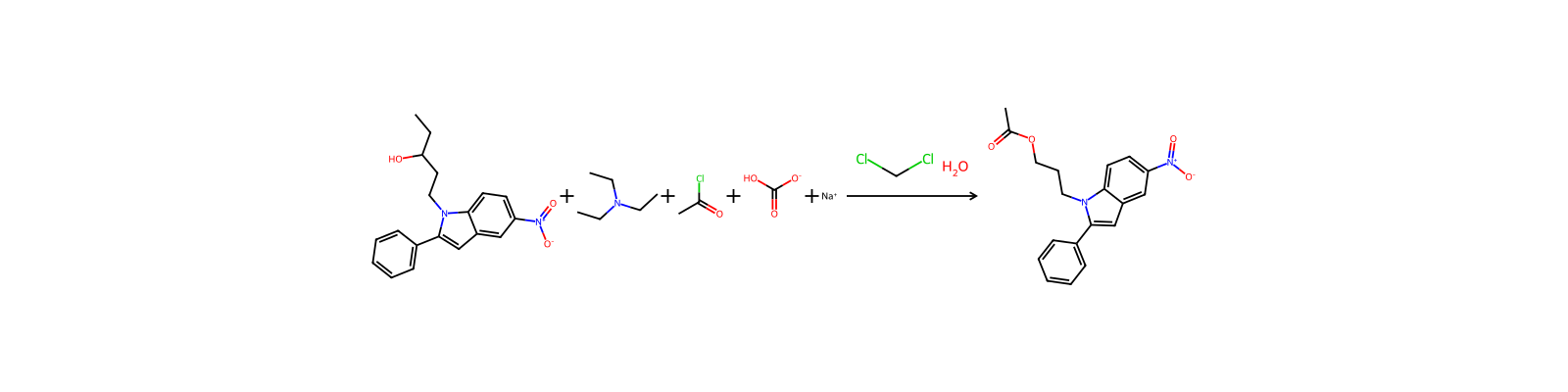
C([CH:3]([OH:24])[CH2:4][CH2:5][N:6]1[C:14]2[C:9](=[CH:10][C:11]([N+:15]([O-:17])=[O:16])=[CH:12][CH:13]=2)[CH:8]=[C:7]1[C:18]1[CH:23]=[CH:22][CH:21]=[CH:20][CH:19]=1)C.C(N(CC)CC)C.[C:32](Cl)(=[O:34])[CH3:33].C([O-])(O)=O.[Na+]>C(Cl)Cl.O>[C:32]([O:24][CH2:3][CH2:4][CH2:5][N:6]1[C:14]2[C:9](=[CH:10][C:11]([N+:15]([O-:17])=[O:16])=[CH:12][CH:13]=2)[CH:8]=[C:7]1[C:18]1[CH:23]=[CH:22][CH:21]=[CH:20][CH:19]=1)(=[O:34])[CH3:33]Participants
7







Procedure
To a solution containing ethyl 3-(5-nitro-2-phenyl-1H-indol-1-yl) propan-1-ol (2.2 g; 7.4 mmol) and triethylamine (1.24 ml; 8.9 mmol) in CH2Cl2 (20 ml), acetyl chloride (0.6 ml; 8.9 mmol) was added dropwise; the reaction mixture was left under stirring at room temperature for 2 hours. Then water (20 ml) and NaHCO3 (saturated solution) were added to pH 7. The biphasic solution was transferred into a separating funnel extracted with CH2Cl2 (2×50 ml). The organic phases were combined, washed with brine (2×100 ml) and dried over Na2SO4. The solvent was removed by evaporation under reduced pressure to give 3-(5-nitro-2-phenyl-1H-indol-1-yl)propyl acetate (1.5 g), which was used without any further purification.
Workup
- additionwas added dropwise
- waitthe reaction mixture was left
- customThe biphasic solution was transferred into a separating funnel
- extractionextracted with CH2Cl2 (2×50 ml)
- washwashed with brine (2×100 ml)
- dry with materialdried over Na2SO4
- customThe solvent was removed by evaporation under reduced pressure
Sources & evidence
- ORD record
- ord-366c2b1d686a432bb2461209352c10db
- Source dataset
- uspto-grants-2014_10
- Patent number
- US08871948B2
Reaction notes
Loading…