Dimethylformamide → Ethyl 2-[2-fluoro-4-(6-chloroquinoxalin-2-yloxy)phenoxy]propionate
Reaction equation

Cl[C:2]1[CH:11]=[N:10][C:9]2[C:4](=[CH:5][CH:6]=[C:7]([Cl:12])[CH:8]=2)[N:3]=1.[F:13][C:14]1[CH:27]=[C:26]([OH:28])[CH:25]=[CH:24][C:15]=1[O:16][CH:17]([CH3:23])[C:18]([O:20][CH2:21][CH3:22])=[O:19].C(=O)([O-])[O-].[K+].[K+].CN(C)C=O>O>[F:13][C:14]1[CH:27]=[C:26]([O:28][C:2]2[CH:11]=[N:10][C:9]3[C:4](=[CH:5][CH:6]=[C:7]([Cl:12])[CH:8]=3)[N:3]=2)[CH:25]=[CH:24][C:15]=1[O:16][CH:17]([CH3:23])[C:18]([O:20][CH2:21][CH3:22])=[O:19]Participants


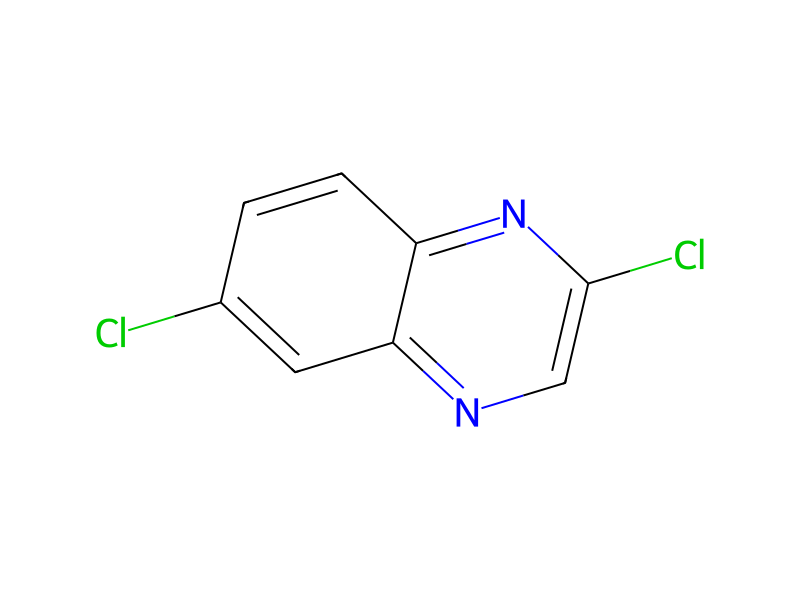



Conditions
- Temperature
- 100 °C
Procedure
A mixture of 2,6-dichloroquinoxaline (0.99 g 0.005 mole), ethyl 2-(2-fluoro-4-hydroxyphenoxy)propionate (1.14 g, 0.005 mole), anhydrous potassium carbonate (0.76 g, 0.0055 mole) and dimethylformamide (20 ml) was stirred and heated at 100° C. for 2 hours. The mixture was cooled and then poured into water (200 ml) to give a white precipitate which was collected by filtration. Recrystallization from ethanol gave the product, ethyl 2-[2-fluoro-4-(6-chloroquinoxalin-2-yloxy)phenoxy]propionate, as colourless crystals (1.3 g; 66%), mp 110° C. Proton magnetic resonance spectrum (CDCl3, δ in ppm); 1.3, t, 3H (CH2CH3); 1.7, d, 3H (CHCH3); 4.3, q, 2H (OCH2CH3); 4.8, q, 1H (CHCH3); 6.9-7.5, m, 3H (phenoxy ring); 7.8, bs, 2H (C7, C8 of quinoxaline); 8.2, bs, 1H (C5 of quinoxaline); 8.8, s, 1H (C3 of quinoxaline).
Workup
- temperatureThe mixture was cooled
- customto give a white precipitate which
- filtrationwas collected by filtration
- customRecrystallization from ethanol
Sources & evidence
- ORD record
- ord-06db50724a2a418b9ebfb4c5a723d009
- Source dataset
- uspto-grants-1987_04
- Patent number
- US04655819
Reaction notes
Loading…