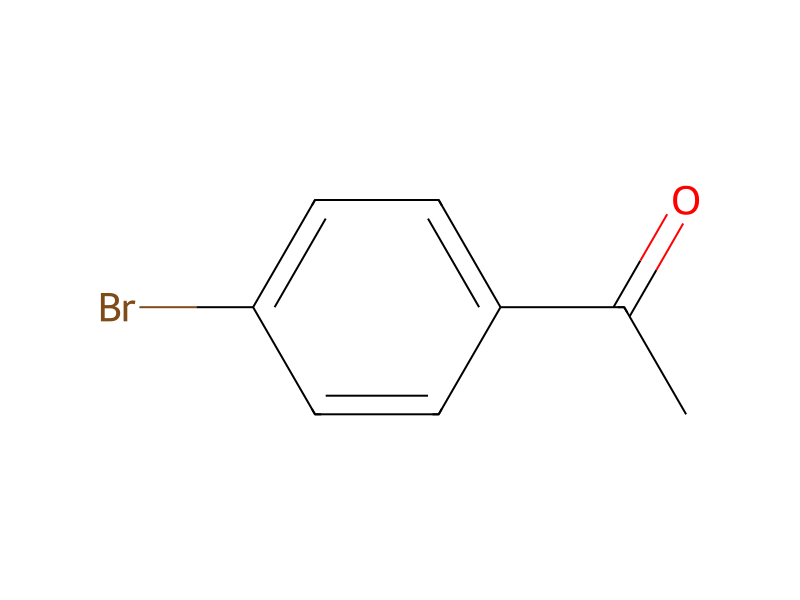
p-Bromoacetophenone → 1-Bromo-4-(prop-1-en-2-yl)benzene
Reaction equation

[Br-].[C:2]1([C:8]([PH3+])([C:15]2C=CC=CC=2)[C:9]2C=CC=CC=2)[CH:7]=[CH:6][CH:5]=[CH:4][CH:3]=1.C([Li])CCC.[Br:27]C1C=CC(C(=O)C)=CC=1>C1COCC1.CCCCCC>[Br:27][C:5]1[CH:6]=[CH:7][C:2]([C:8]([CH3:15])=[CH2:9])=[CH:3][CH:4]=1Participants





Conditions
- Temperature
- 0 °C
Procedure
To a slurry of triphenylmethylphosphonium bromide (71.4 g, 200 mmole), in 500 ml dry THF at 0° C., were slowly added dropwise 135 ml (200 mmole) 1.44 M n-butyllithium in hexane. The mixture was stirred 30 minutes at 0° C., and a solution of 39.8 g (200 mmole) p-bromoacetophenone, in 100 ml dry THF, was slowly added dropwise. The mixture was allowed to warm slowly to ambient temperature, whereafter stirring was continued overnight. The stirred mixture was next filtered and the solvent removed by careful distillation at atmospheric pressure, the resulting residue was diluted with hexane, filtered, and the hexane removed by distillation. The remaining material was distilled, using a water aspirator vacuum, to produce 23.2 g (58.3% yield) of p-bromo-α-methylstyrene, bp 95°-98° C.
Workup
- temperatureto warm slowly to ambient temperature
- stirringwhereafter stirring
- waitwas continued overnight
- filtrationThe stirred mixture was next filtered
- customthe solvent removed by careful distillation at atmospheric pressure
- additionthe resulting residue was diluted with hexane
- filtrationfiltered
- customthe hexane removed by distillation
- distillationThe remaining material was distilled
Sources & evidence
- ORD record
- ord-2fd29c4ecfc743fc98fae64721d15d67
- Source dataset
- uspto-grants-1984_05
- Patent number
- US04447542
Reaction notes
Loading…