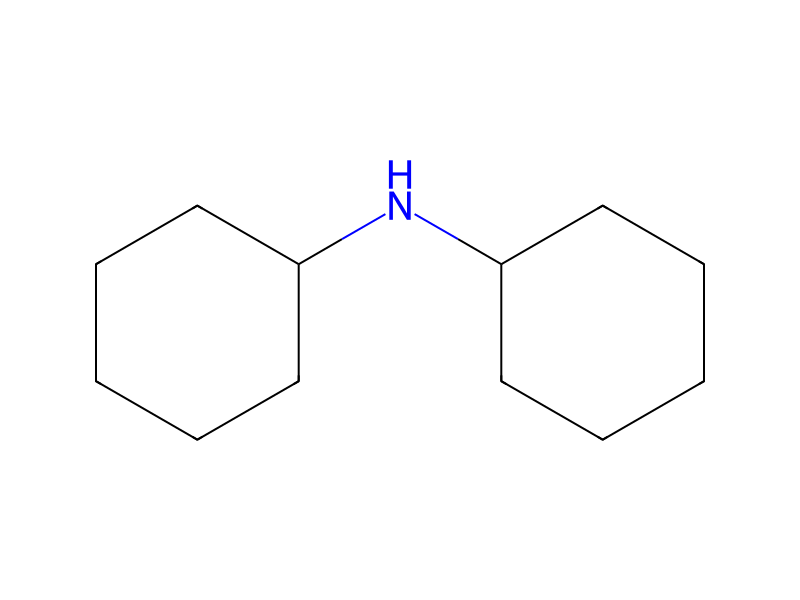
Dicyclohexylamine → Dicyclohexylamine
Reaction equation

C(=O)([O-])[O-].[K+].[K+].Br[CH2:8][CH:9]([CH3:20])[C:10]([N:12]1[C@H:16]([C:17]([OH:19])=[O:18])[CH2:15][S:14][CH2:13]1)=[O:11].[Cl:21][C:22]1[CH:30]=[CH:29][C:25]([C:26]([O-:28])=[S:27])=[CH:24][C:23]=1[S:31](=[O:34])(=[O:33])[NH2:32].[K+].[CH:36]1([NH:42][CH:43]2[CH2:48][CH2:47][CH2:46][CH2:45][CH2:44]2)[CH2:41][CH2:40][CH2:39][CH2:38][CH2:37]1>O>[CH:43]1([NH:42][CH:36]2[CH2:37][CH2:38][CH2:39][CH2:40][CH2:41]2)[CH2:44][CH2:45][CH2:46][CH2:47][CH2:48]1.[Cl:21][C:22]1[CH:30]=[CH:29][C:25]([C:26]([S:27][CH2:8][C@@H:9]([CH3:20])[C:10]([N:12]2[C@H:16]([C:17]([OH:19])=[O:18])[CH2:15][S:14][CH2:13]2)=[O:11])=[O:28])=[CH:24][C:23]=1[S:31](=[O:34])(=[O:33])[NH2:32]Participants
7




Procedure
A solution of 1.4 g of potassium carbonate in 30 ml of water is added to 2.8 g of 3-(3-bromo-2-methylpropionyl)-4(R)-thiazolidinecarboxylic acid whereupon 3 g of potassium 4-chloro-3-sulfamoyl-thiobenzoate is added slowly under ice-cooling and stirring, and the resulting mixture is stirred at room temperature for 4 hours. The reaction mixture is then treated in an analogous manner of Example 1, and the oily residue thus obtained is converted in a conventional manner into the dicyclohexylamine salt. Thus is obtained dicyclohexylamine salt of 3-[3-(4-chloro-3-sulfamoylbenzoylthio)-2(S)-methylpropionyl]-4(R)-thiazolidinecarboxylic acid as white crystalline powder, melting at 173°-176° C. (recrystallized twice from isopropanol).
Workup
- additionis added slowly under ice-
- temperaturecooling
- stirringthe resulting mixture is stirred at room temperature for 4 hours
- additionThe reaction mixture is then treated in an analogous manner of Example 1
- customthe oily residue thus obtained
Sources & evidence
- ORD record
- ord-85874b7c453b476f95a6972907cd04f2
- Source dataset
- uspto-grants-1984_05
- Patent number
- US04450275
Reaction notes
Loading…