Triethylamine → 5-bromo-2-chloro-N-cyclopropylpyrimidin-4-amine
Reaction equation

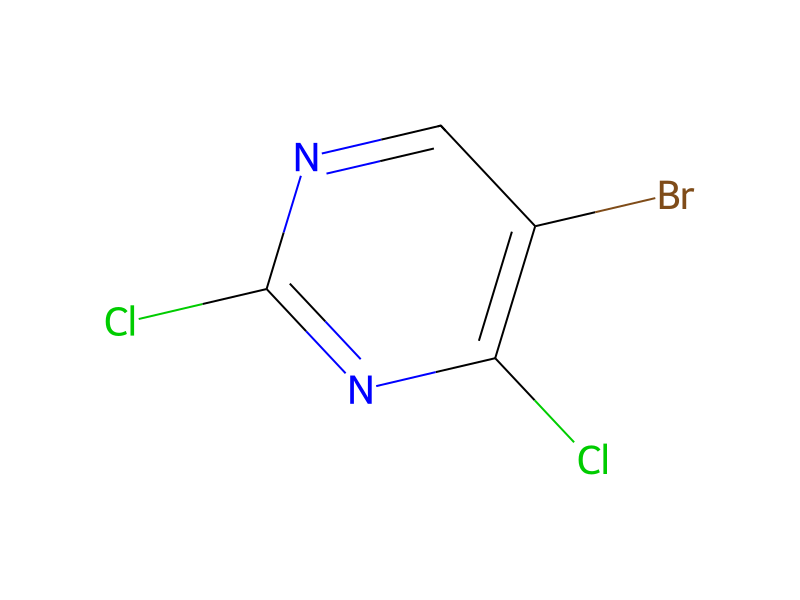
[Br:1][C:2]1[C:3](Cl)=[N:4][C:5]([Cl:8])=[N:6][CH:7]=1.[CH:10]1([NH2:13])[CH2:12][CH2:11]1.C(N(CC)CC)C>C(#N)C>[Br:1][C:2]1[C:3]([NH:13][CH:10]2[CH2:12][CH2:11]2)=[N:4][C:5]([Cl:8])=[N:6][CH:7]=1Participants
5
Reactant 3


Product 1

Reagents, catalysts & solvents 1

Procedure
In analogy to compound 1.1, a solution of 1.0 g (4.39 mmol) of 5-bromo-2,4-dichloro-pyrimidine in 15 ml of acetonitrile is reacted with 0.27 g (4.74 mmol) of cyclopropylamine in the presence of 0.74 ml (5.3 mmol) of triethylamine. Purification by chromatography (silica gel, ethyl acetate/hexane with ethyl acetate 0-100%) results in 0.76 g (70% of theory) of the product.
Workup
- customPurification by chromatography (silica gel, ethyl acetate/hexane with ethyl acetate 0-100%)
- customresults in 0.76 g (70% of theory) of the product
Sources & evidence
- ORD record
- ord-c6947fc32e584b219d530c30dbe95642
- Source dataset
- uspto-grants-2011_05
- Patent number
- US07943629B2
Reaction notes
Loading…