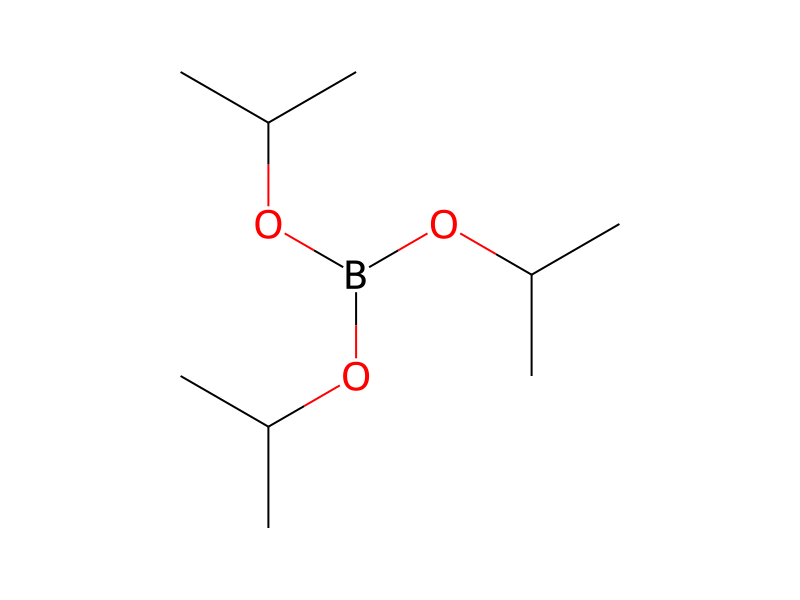
Triisopropyl borate → HCID 59887844, compound
Reaction equation

Br[C:2]1[CH:11]=[C:10]2[C:5]([CH:6]=[CH:7][N:8]=[C:9]2[Cl:12])=[CH:4][CH:3]=1.[B:13](OC(C)C)([O:18]C(C)C)[O:14]C(C)C.C([Li])CCC>C1COCC1>[Cl:12][C:9]1[C:10]2[C:5](=[CH:4][CH:3]=[C:2]([B:13]([OH:18])[OH:14])[CH:11]=2)[CH:6]=[CH:7][N:8]=1Participants
5
Reactant 3


Product 1

Reagents, catalysts & solvents 1

Conditions
- Temperature
- -20 °C
Procedure
7-Bromo-1-chloroisoquinoline (1.38 g, 5.69 mmol) in THF (15 mL) under nitrogen, at −78° C. and triisopropyl borate (2.99 g, 15.93 mmol) added, followed by dropwise addition of n-butyllithium (7.11 mL of 1.6M in hexanes, 11.38 mmol). Allowed reaction mixture to warm to −20° C. over 30 minutes and quenched with 1N HCl (30 mL). Added triethylamine to give pH 7, presorbed solution directly onto silica and flash column chromatography on silica gel to give the product as pale yellow solid (0.78 g, 3.8 mmol). 1H NMR (DMSO) δ 8.73 (s, 1H), 8.48 (br s, 2H), 8.35-8.28 (m, 1H), 8.25-8.13 (m, 1H), 8.06-7.92 (m, 1H), 7.91-7.82 (m, 1H). ESI MS (M+1)+: 208, 210 (Cl).
Workup
- customAllowed reaction mixture
- customquenched with 1N HCl (30 mL)
- customAdded triethylamine to give pH 7
Sources & evidence
- ORD record
- ord-c44ce3d9b10a428fb97dc3c9446e45ee
- Source dataset
- uspto-grants-2011_05
- Patent number
- US07947684B2
Reaction notes
Loading…