Dichloromethane → ethyl 1-(3,4-dihydroquinolin-1(2H)-ylcarbonyl)piperidine-4-carboxylate
Reaction equation

[I-].[N:2]1([C:12]([N:14]2[CH:18]=[CH:17][N+](C)=[CH:15]2)=[O:13])[C:11]2[C:6](=[CH:7][CH:8]=[CH:9][CH:10]=2)[CH2:5][CH2:4][CH2:3]1.ClCCl.N1CC[CH:26]([C:27]([O:29][CH2:30][CH3:31])=[O:28])[CH2:25]C1>C(N(CC)CC)C>[N:2]1([C:12]([N:14]2[CH2:15][CH2:25][CH:26]([C:27]([O:29][CH2:30][CH3:31])=[O:28])[CH2:17][CH2:18]2)=[O:13])[C:11]2[C:6](=[CH:7][CH:8]=[CH:9][CH:10]=2)[CH2:5][CH2:4][CH2:3]1Participants
5
Reactant 3

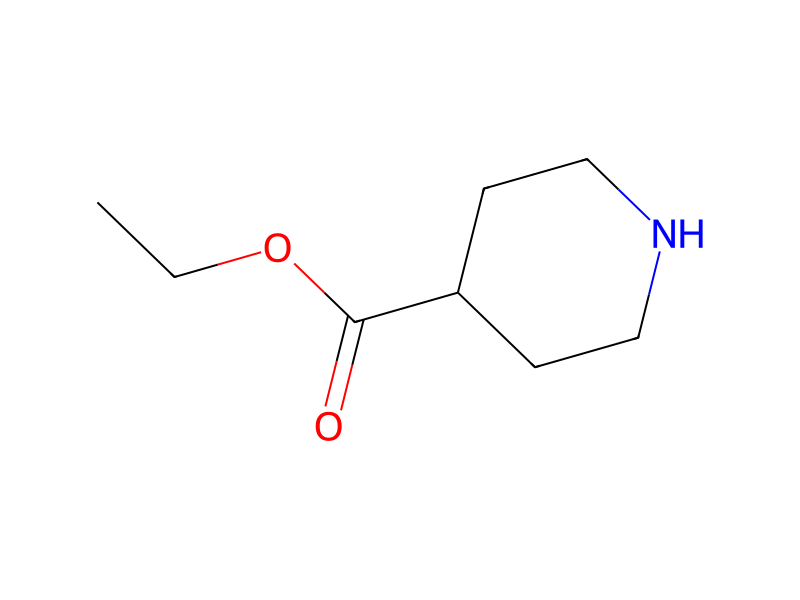

Product 1

Reagents, catalysts & solvents 1

Procedure
16.5 g of 1-(3,4-dihydroquinolin-1(2H)-ylcarbonyl)-3-methyl-1H-imidazol-3-ium iodide, 224 ml of dichloromethane and 8.45 g of ethyl isonipecotate, followed by 31.22 ml of triethylamine, are introduced into a 500 ml round-bottomed flask. The reaction medium is stirred at ambient temperature for 20 hours. The solvent is evaporated under reduced pressure and the residue is taken up in ethyl acetate and then washed with water. The organic phase is dried over sodium sulfate and the solvent is evaporated under reduced pressure to result in 15.2 g of ethyl 1-(3,4-dihydroquinolin-1(2H)-ylcarbonyl)piperidine-4-carboxylate.
Workup
- additionare introduced into a 500 ml round-bottomed flask
- customThe solvent is evaporated under reduced pressure
- washwashed with water
- dry with materialThe organic phase is dried over sodium sulfate
- customthe solvent is evaporated under reduced pressure
- customto result in 15.2 g of ethyl 1-(3,4-dihydroquinolin-1(2H)-ylcarbonyl)piperidine-4-carboxylate
Sources & evidence
- ORD record
- ord-fbfd70cf10784e6ea6e2b306b0312358
- Source dataset
- uspto-grants-2011_05
- Patent number
- US07947834B2
Reaction notes
Loading…