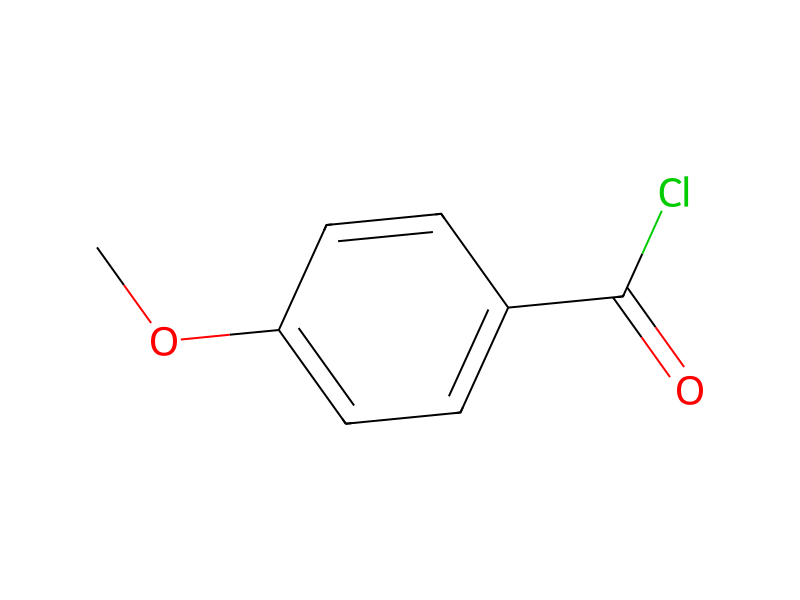
p-Anisoyl chloride → HCID 67165918, compound
Reaction equation

[NH:1]1[C:10]2[C:5](=[CH:6][CH:7]=[CH:8][CH:9]=2)[CH:4]([C:11]([OH:13])=[O:12])[CH2:3][CH2:2]1.[C:14](Cl)(=[O:23])[C:15]1[CH:20]=[CH:19][C:18]([O:21][CH3:22])=[CH:17][CH:16]=1.C(N(C(C)C)CC)(C)C>O1CCCC1>[CH3:22][O:21][C:18]1[CH:19]=[CH:20][C:15]([C:14]([N:1]2[C:10]3[C:5](=[CH:6][CH:7]=[CH:8][CH:9]=3)[CH:4]([C:11]([OH:13])=[O:12])[CH2:3][CH2:2]2)=[O:23])=[CH:16][CH:17]=1Participants
Reactant 3


Product 1

Reagents, catalysts & solvents 1

Procedure
1,2,3,4-Tetrahydro-quinoline-4-carboxylic acid (305 mg, 1.89 mmol) was dissolved in anhydrous tetrahydrofuran (10 mL). Anisoyl chloride (644 mg, 3.78 mmol) was added followed by diisopropylethylamine (733 mg, 1.01 mL, 15.67 mmol). The reaction was stirred at room temperature for 7 days. The mixture was concentrated and partitioned between chloroform and sodium hydroxide (1 M, aqueous). The chloroform extract was set aside. The aqueous phase was acidified with concentrated hydrochloric acid (pH=3-4). The aqueous phase was then extracted with ethyl acetate (three times). The combined extracts were washed with brine, dried over sodium sulfate, filtered, and concentrated. The crude product was used without further purification. MS m/z: 312 (M+1).
Workup
- concentrationThe mixture was concentrated
- custompartitioned between chloroform and sodium hydroxide (1 M, aqueous)
- extractionThe chloroform extract
- extractionThe aqueous phase was then extracted with ethyl acetate (three times)
- washThe combined extracts were washed with brine
- dry with materialdried over sodium sulfate
- filtrationfiltered
- concentrationconcentrated
- customThe crude product was used without further purification
Sources & evidence
- ORD record
- ord-54813765b992474bbdfb40b73c57ab4e
- Source dataset
- uspto-grants-2011_05
- Patent number
- US07951950B2
Reaction notes
Loading…