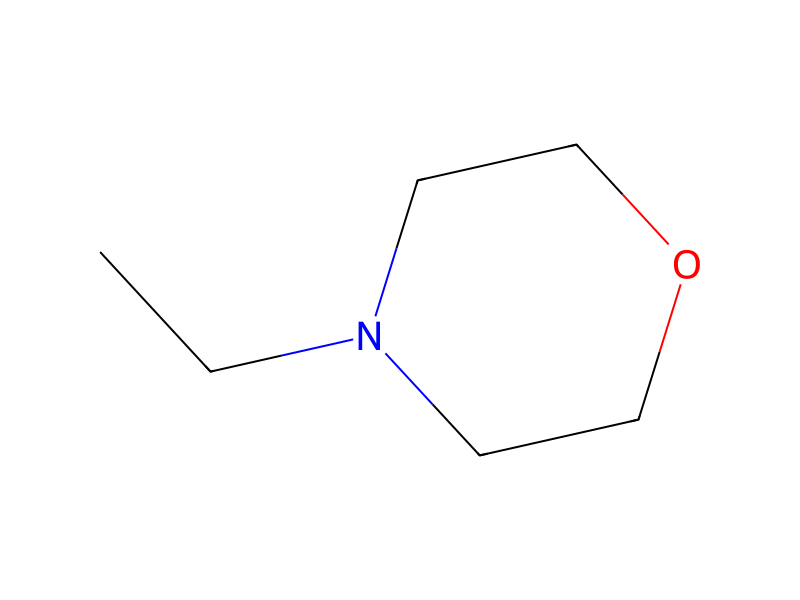
Ethylmorpholine → 1-methyl-N-(1-naphthalenylmethyl)-5-oxoprolinamide
Reaction equation

[CH3:1][N:2]1[C:9](=[O:10])[CH2:8][CH2:7][C@H:3]1[C:4]([OH:6])=O.Cl.CN(C)CCCN=C=NCC.ON1C2C=CC=CC=2N=N1.C(N1CCOCC1)C.[C:41]1([CH2:51][NH2:52])[C:50]2[C:45](=[CH:46][CH:47]=[CH:48][CH:49]=2)[CH:44]=[CH:43][CH:42]=1>ClCCl>[CH3:1][N:2]1[C:9](=[O:10])[CH2:8][CH2:7][C@H:3]1[C:4]([NH:52][CH2:51][C:41]1[C:50]2[C:45](=[CH:46][CH:47]=[CH:48][CH:49]=2)[CH:44]=[CH:43][CH:42]=1)=[O:6]Participants
Reactant 5




Product 1

Reagents, catalysts & solvents 1

Procedure
1-methyl-5-oxoproline (0.050 g, 0.35 mmol, prepared in a manner analogous to that described above for example 51), N-(3-dimethylaminopropyl)-N′-ethylcarbodiimide hydrochloride (0.081 g, 0.42 mmol), 1-hydroxybenzotriazole (0.057 g, 0.42 mmol), N-ethyl morpholine (0.166 ml, 1.05 mmol) and (1-naphthalenylmethyl)amine were combined in dichloromethane (˜8 ml) and the mixture was stirred for ˜20 hrs at room temperature. The mixture was then washed with 2M aqueous hydrogen chloride (5 ml) and the organic layer was separated using a phase separator. The organic layer was washed with saturated aqueous sodium hydrogen carbonate, separated as before, and then evaporated. The residue was purified by mass-directed automated HPLC to give pure 1-methyl-N-(1-naphthalenylmethyl)-5-oxoprolinamide as a white solid (0.062 g).
Workup
- washThe mixture was then washed with 2M aqueous hydrogen chloride (5 ml)
- customthe organic layer was separated
- washThe organic layer was washed with saturated aqueous sodium hydrogen carbonate
- customseparated as before, and
- customthen evaporated
- customThe residue was purified
Sources & evidence
- ORD record
- ord-a380b0866e184bcb9e2515ba9b82ce2d
- Source dataset
- uspto-grants-2011_11
- Patent number
- US08048907B2
Reaction notes
Loading…