Dimethylformamide → 4-Chloro-1-((2-(trimethylsilyl)ethoxy)methyl)-1H-pyrrolo(2,3-b)pyridine
Reaction equation

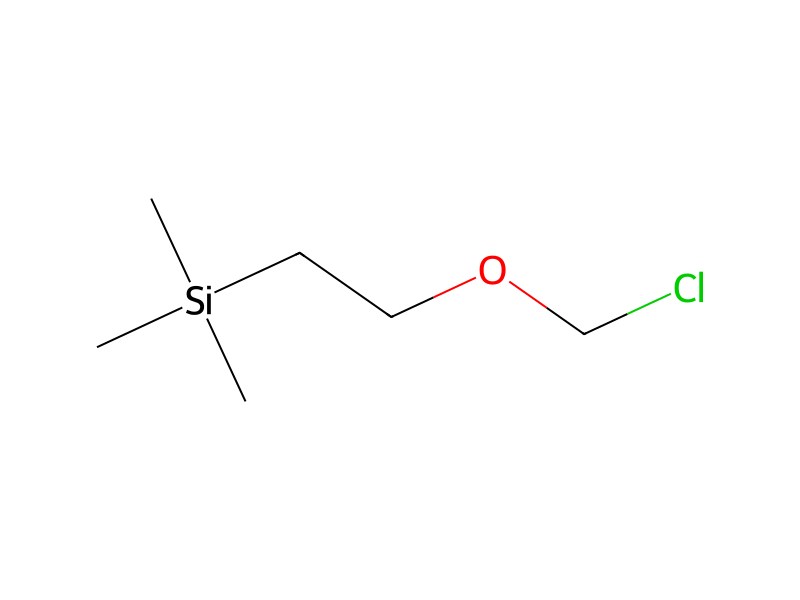
[Cl:1][C:2]1[CH:7]=[CH:6][N:5]=[C:4]2[NH:8][CH:9]=[CH:10][C:3]=12.[CH3:11][Si:12]([CH3:19])([CH3:18])[CH2:13][CH2:14][O:15][CH2:16]Cl.CN(C)C=O.[H-].[Na+]>>[Cl:1][C:2]1[CH:7]=[CH:6][N:5]=[C:4]2[N:8]([CH2:16][O:15][CH2:14][CH2:13][Si:12]([CH3:19])([CH3:18])[CH3:11])[CH:9]=[CH:10][C:3]=12Participants
5




Procedure
To a 0° C. solution of 4-chloro-1H-pyrrolo[2,3-b]pyridine (0.50 g, 0.0033 mol) and [β-(trimethylsilyl)ethoxy]methyl chloride (0.75 mL, 0.0043 mol) in N,N-dimethylformamide (5 mL, 0.06 mol) was added sodium hydride (0.17 g, 0.0043 mol). The resulting mixture was stirred overnight and partitioned between ethyl acetate and water (×2), and the organic layer was washed with sat. NaCl. The organic layer was then dried under vacuum to produce 1.05 g of an orange oil which was chromatographed with 15% ethyl acetate/hex to give 830 mg of a colorless oil (89.6% yield).
Workup
- custompartitioned between ethyl acetate and water (×2)
- washthe organic layer was washed with sat. NaCl
- customThe organic layer was then dried under vacuum
Sources & evidence
- ORD record
- ord-3fda4856cbd045d6868fd7adf980b65c
- Source dataset
- uspto-grants-2011_11
- Patent number
- US08053433B2
Reaction notes
Loading…