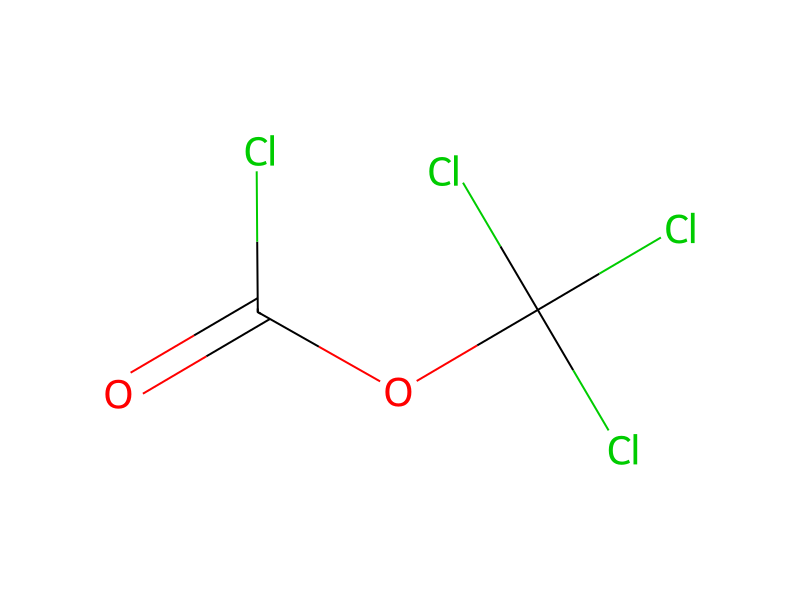
Diphosgene → Methyl trans-4-cyanocyclohexanecarboxylate
Reaction equation

[CH3:1][O:2][C:3]([CH:5]1[CH2:10][CH2:9][CH:8]([C:11](=O)[NH2:12])[CH2:7][CH2:6]1)=[O:4].O=C(Cl)OC(Cl)(Cl)Cl>P(OC)(OC)(OC)=O.C(OCC)(=O)C>[CH3:1][O:2][C:3]([CH:5]1[CH2:10][CH2:9][CH:8]([C:11]#[N:12])[CH2:7][CH2:6]1)=[O:4]Participants
5
Reactant 2

Product 1

Reagents, catalysts & solvents 2


Procedure
To a mixture of 4-carbamoyl-cyclohexanecarboxylic acid methyl ester (2.14 g, 11.6 mmol) in trimethyl phosphate (14 mL) cooled in an ice bath was dripped in diphosgene (2.24 g 11.6 mmol) and the reaction was allowed to warm to room temperature over 2 hr. The material was diluted with ethyl acetate (200 mL) and washed with an aqueous sodium bicarbonate (saturated, 200 mL) and brine (200 mL), dried over sodium sulfate, and concentrated as a clear oil. The oil was triturated with hexanes to give 4-cyano-cyclohexanecarboxylic acid methyl ester (687 mg 36%) as a clear oil. LCMS calcd for C9H13NO2 (m/e) 167, obsd 168 (M+H).
Workup
- temperaturecooled in an ice bath
- washwashed with an aqueous sodium bicarbonate (saturated, 200 mL) and brine (200 mL)
- dry with materialdried over sodium sulfate
- concentrationconcentrated as a clear oil
- customThe oil was triturated with hexanes
Sources & evidence
- ORD record
- ord-5140b9ca90294c00bb24354e3aac0513
- Source dataset
- uspto-grants-2011_11
- Patent number
- US08058299B2
Reaction notes
Loading…