反应详情
EQUATION
反应方程式

REACTANTS
反应物

PRODUCTS
产物

AUXILIARIES
试剂、催化剂与溶剂
CONDITIONS
反应条件
- 温度
- 0 °C
PROCEDURE
实验过程
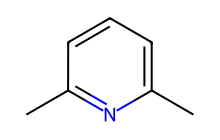
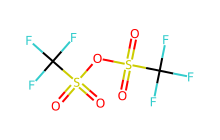
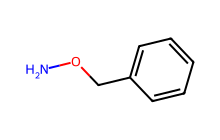
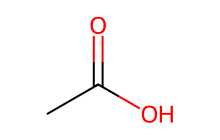
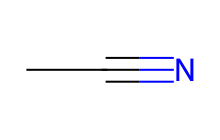
A solution of 47.9 g (161 mmol) of (2S,5S)-tert-butyl 5-hydroxy-1-(2,2,2-trifluoroacetyl)piperidine-2-carboxylate in dehydrated acetonitrile (318 mL) was cooled from −30 to −40° C. under argon atmosphere, and 20.5 mL (177 mmol) of 2,6-lutidine was added, and then 28.4 mL (169 mmol) of trifluoromethanesulfonic acid anhydride was added dropwise over 40 minutes, followed by further allowing to react at −30° C. for 15 minutes. To this reaction mixture was added 39.7 g (322 mmol) of benzyloxyamine (washed with acetonitrile (11 mL)) within 8 minutes, followed by raising the temperature to 0° C. within 30 minutes, and further 20.5 mL (177 mmol) of 2,6-lutidine was added, followed by allowing to react at 0 to 5° C. for 2 days. This reaction mixture was concentrated under reduced pressure, and the resulting residue was diluted with ethyl acetate (960 mL) and washed sequentially with water (960 mL), 10% aqueous citric acid solution (960 mL×3 times), 6.5% aqueous sodium hydrogencarbonate solution (480 mL) and saturated brine (480 mL). Each aqueous layer was back-extracted with ethyl acetate (960 mL), the organic layers were combined, and the solvent was distilled off under reduced pressure. The resulting residue was dissolved in 1,4-dioxane (320 mL) solution and water (86 mL), and, under ice cooling, 2.5M NaOH (128 mL) was added dropwise, followed by allowing to react at the same temperature for 0.5 hours. Acetic acid (ca. 9.3 mL) was added to the reaction mixture, followed by concentration under reduced pressure, and subsequently the resulting concentrated residue was extracted with ethyl acetate (580 mL, 290 mL). After the organic layers were washed respectively with 50% aqueous potassium carbonate solution (580 mL), they were combined, and the solvent was distilled off under reduced pressure. The resulting residue was applied to silica gel column chromatography (hexane/ethyl acetate=4/1→0/1→ethyl acetate/methanol=100/1→19/1) to afford 36.58 g of the title compound as a colorless oil (yield 74%). Instrumental data were consistent with those of Example 4.
WORKUP
后处理
- customto react at −30° C. for 15 minutes
- customto react at 0 to 5° C. for 2 days
- concentrationThis reaction mixture was concentrated under reduced pressure
- additionthe resulting residue was diluted with ethyl acetate (960 mL)
- washwashed sequentially with water (960 mL), 10% aqueous citric acid solution (960 mL×3 times), 6.5% aqueous sodium hydrogencarbonate solution (480 mL) and saturated brine (480 mL)
- extractionEach aqueous layer was back-extracted with ethyl acetate (960 mL)
- distillationthe solvent was distilled off under reduced pressure
- dissolutionThe resulting residue was dissolved in 1,4-dioxane (320 mL) solution and water (86 mL)
- additionunder ice cooling, 2.5M NaOH (128 mL) was added dropwise
- customto react at the same temperature for 0.5 hours
- concentrationfollowed by concentration under reduced pressure
- extractionsubsequently the resulting concentrated residue was extracted with ethyl acetate (580 mL, 290 mL)
- washAfter the organic layers were washed respectively with 50% aqueous potassium carbonate solution (580 mL), they
- distillationthe solvent was distilled off under reduced pressure