Proton sponge → HCID 131732860, compound
Reaction equation

[Cl:1][C:2]1[CH:3]=[C:4]([CH:9]2[C:18]3[C:13](=[CH:14][C:15]([C:20]4[N:21]=[N:22][C:23]([C:26]([F:29])([F:28])[F:27])=[CH:24][CH:25]=4)=[C:16]([F:19])[CH:17]=3)[CH2:12][N:11](C)[CH2:10]2)[CH:5]=[CH:6][C:7]=1[Cl:8].CN(C)C1C2C(=CC=CC=2N(C)C)C=CC=1.ClC(OC(Cl)C)=O.[C:54]([OH:63])(=[O:62])[C@@H:55]([C@H:57]([C:59]([OH:61])=[O:60])[OH:58])[OH:56]>ClCCCl.C(Cl)Cl.C(#N)C.O>[C:59]([C@@H:57]([C@H:55]([C:54]([OH:63])=[O:62])[OH:56])[OH:58])([OH:61])=[O:60].[Cl:1][C:2]1[CH:3]=[C:4]([CH:9]2[C:18]3[C:13](=[CH:14][C:15]([C:20]4[N:21]=[N:22][C:23]([C:26]([F:27])([F:29])[F:28])=[CH:24][CH:25]=4)=[C:16]([F:19])[CH:17]=3)[CH2:12][NH:11][CH2:10]2)[CH:5]=[CH:6][C:7]=1[Cl:8]Participants
Reactant 4

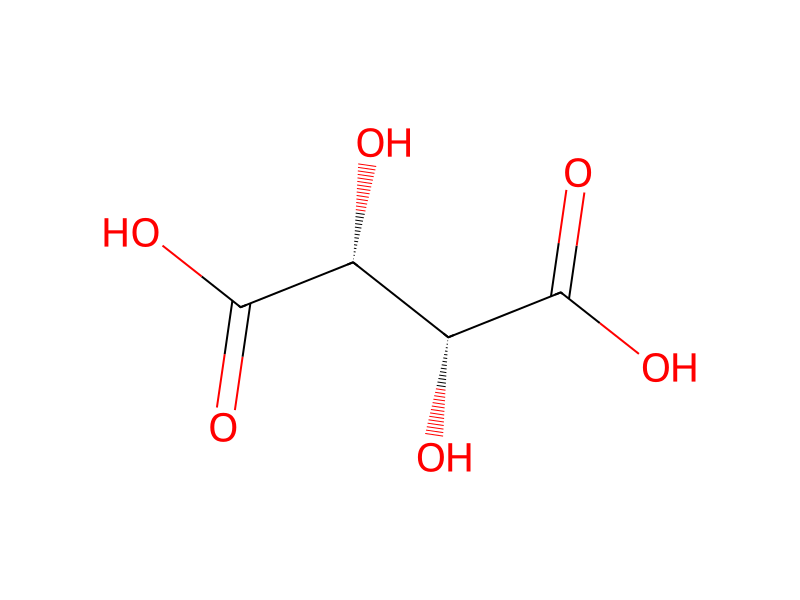


Product 1

Reagents, catalysts & solvents 4




Procedure
To (+)-4-(3,4-dichlorophenyl)-6-fluoro-2-methyl-7-(6-(trifluoromethyl)pyridazin-3-yl)-1,2,3,4-tetrahydroisoquinoline (320 mg, 0.70 mmol) and N1,N1,N8,N8-tetramethylnaphthalene-1,8-diamine (299 mg, 0.70 mmol) in 1,2-dichloroethane (5 mL) was added 1-chlorethyl chloroformate (0.15 mL, 1.4 mmol) drop wise. The mixture was heated to reflux for 3 hours and then cooled to ambient temperature. The reaction mixture was diluted with methylene chloride (30 mL) and washed with 1N HCl (10 mL), water (10 mL), dried over sodium sulfate, filtered, and concentrated in vacuo. To the residue was added methanol (15 mL) and the mixture was heated to reflux. After 1 hour, the reaction mixture was cooled to ambient temperature and concentrated under reduced pressure. The residue was taken up in ethyl acetate (30 mL) and washed with saturated aqueous sodium bicarbonate (10 mL), water (10 mL), brine (10 mL), dried over sodium sulfate, filtered, and concentrated in vacuo. The residue was purified by column chromatography (methylene chloride to 90:9:1 methylene chloride/methanol/ammonium hydroxide) and preparative TLC (90:9:1 methylene chloride/methanol/ammonium hydroxide). To the obtained material in acetonitrile (1.5 mL) was added L-tartaric acid (9.2 mg, 0.06 mmol) in water (5 mL). The resultant solution was lyophilized to give (+)-4-(3,4-dichlorophenyl)-6-fluoro-7-(6-(trifluoromethyl)pyridazin-3-yl)-1,2,3,4-tetrahydroisoquinoline, L-tartrate salt (47 mg, 11%) as a white powder: 1H NMR (CD3OD, 500 MHz) δ 8.32 (d, J=8.5 Hz, 1H), 8.19 (d, J=9.0 Hz, 1H), 8.07 (d, J=7.0 Hz, 1H), 7.57 (d, J=8.0 Hz, 1H), 7.51 (d, J=1.5 Hz, 1H), 7.24 (dd, J=8.5, 2.0 Hz, 1H), 6.85 (d, J=11.5 Hz, 1H), 4.59-4.48 (m, 3H), 4.41 (s, 1.8H), 3.77-3.71 (m, 1H), 3.40-3.38 (m, 1H); ESI MS m/z 442 [M+H]+.
Workup
- temperatureThe mixture was heated
- temperatureto reflux for 3 hours
- washwashed with 1N HCl (10 mL), water (10 mL)
- dry with materialdried over sodium sulfate
- filtrationfiltered
- concentrationconcentrated in vacuo
- additionTo the residue was added methanol (15 mL)
- temperaturethe mixture was heated to reflux
- temperaturethe reaction mixture was cooled to ambient temperature
- concentrationconcentrated under reduced pressure
- washwashed with saturated aqueous sodium bicarbonate (10 mL), water (10 mL), brine (10 mL)
- dry with materialdried over sodium sulfate
- filtrationfiltered
- concentrationconcentrated in vacuo
- customThe residue was purified by column chromatography (methylene chloride to 90:9:1 methylene chloride/methanol/ammonium hydroxide) and preparative TLC (90:9:1 methylene chloride/methanol/ammonium hydroxide)
Sources & evidence
- ORD record
- ord-bc7ee5312ce6465ba215f191c2c0d2d9
- Source dataset
- uspto-grants-2015_05
- Patent number
- US09034899B2
Reaction notes
Loading…