Hydrochloric Acid → Ethyl 2,4-diethylpyridine-3-carboxylate
Reaction equation
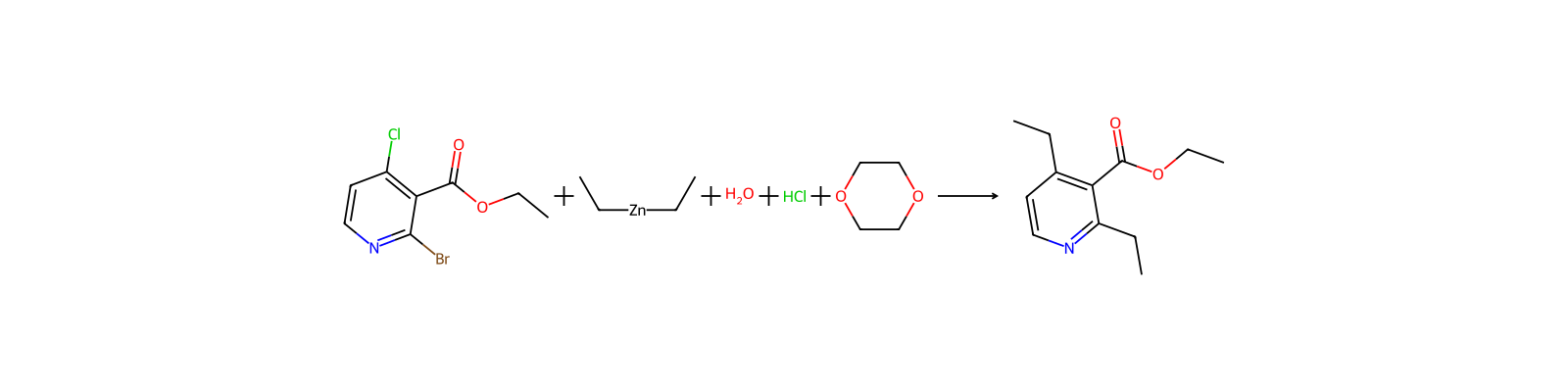
Br[C:2]1[C:7]([C:8]([O:10][CH2:11][CH3:12])=[O:9])=[C:6](Cl)[CH:5]=[CH:4][N:3]=1.[CH2:14]([Zn]CC)[CH3:15].O.Cl.O1CCO[CH2:23][CH2:22]1>>[CH2:14]([C:2]1[C:7]([C:8]([O:10][CH2:11][CH3:12])=[O:9])=[C:6]([CH2:22][CH3:23])[CH:5]=[CH:4][N:3]=1)[CH3:15]Participants
6





Conditions
- Temperature
- 70 °C
Procedure
Ethyl 2-bromo-4-chloropyridine-3-carboxylate (2.0 g, 7.6 mmol) was dissolved in anhydrous dioxane (55 mL). A solution of diethyl zinc (6.9 mL, 7.6 mmol, 1.1 M in toluene) was added dropwise, and then was added (1,1′-bis(diphenylphosphino)ferrocene)dichloropalladium (83 mg, 113 μmol). The mixture was heated at 70° C. for 6 hours, and water followed by 1 N HCl was added. The mixture was extracted 3 times with ethyl acetate, and the combined organic phases were washed with brine and dried over sodium sulfate. After evaporation, the residue was dissolved in DCM and purified on silica gel using 0-20% hexane/ethyl acetate to afford ethyl 2,4-diethylpyridine-3-carboxylate (720 mg, 46% yield).
Workup
- additionwas added
- extractionThe mixture was extracted 3 times with ethyl acetate
- washthe combined organic phases were washed with brine
- dry with materialdried over sodium sulfate
- customAfter evaporation
- dissolutionthe residue was dissolved in DCM
- custompurified on silica gel using 0-20% hexane/ethyl acetate
Sources & evidence
- ORD record
- ord-b8727495d6ba423499299407a0bf4e29
- Source dataset
- uspto-grants-2015_05
- Patent number
- US09040538B2
Reaction notes
Loading…