Cesium carbonate → 4-(2-Fluoro-4-nitrophenyl)morpholin-3-one
Reaction equation
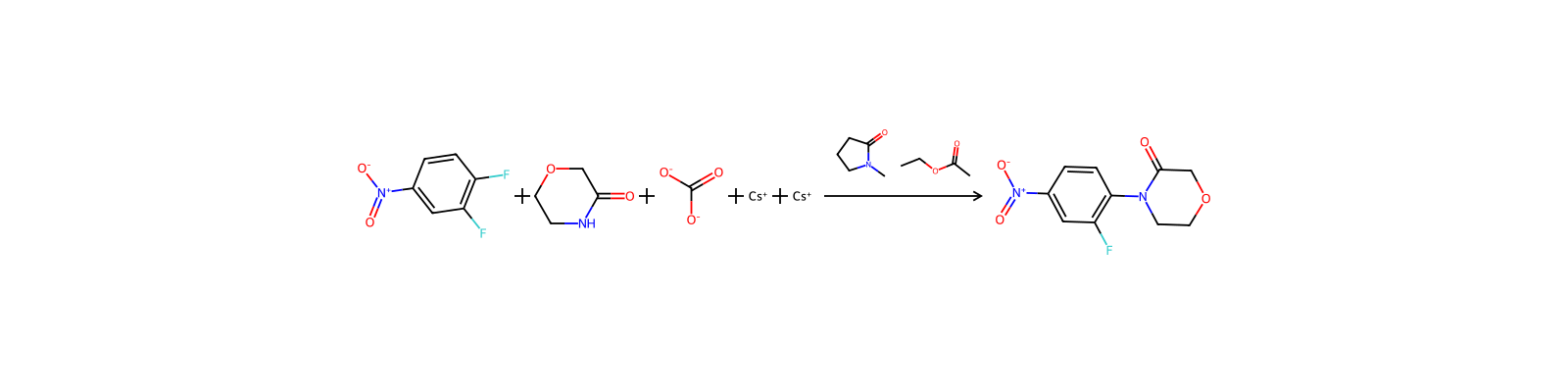
[F:1][C:2]1[CH:3]=[C:4]([N+:9]([O-:11])=[O:10])[CH:5]=[CH:6][C:7]=1F.[NH:12]1[CH2:17][CH2:16][O:15][CH2:14][C:13]1=[O:18].C(=O)([O-])[O-].[Cs+].[Cs+]>CN1C(=O)CCC1.CCOC(C)=O>[F:1][C:2]1[CH:3]=[C:4]([N+:9]([O-:11])=[O:10])[CH:5]=[CH:6][C:7]=1[N:12]1[CH2:17][CH2:16][O:15][CH2:14][C:13]1=[O:18]Participants





Conditions
- Temperature
- 120 °C
Procedure
3,4-Difluoro-1-nitrobenzene (0.50 mL, 4.52 mmol) was dissolved in 8 mL NMP. To it was added morpholin-3-one (0.91 g, 9.04 mmol) and cesium carbonate (2.95 g, 9.04 mmol). The mixture was stirred at 120° C. for 6 h. It was cooled to RT, diluted with 200 mL EtOAc, washed with brine three times, dried, concentrated in vacuo and subjected to silica flash column (0-30% EtOAc in DCM) to isolate 4-(2-fluoro-4-nitrophenyl)morpholin-3-one (580 mg, 53%). It was dissolved in 200 mL EtOAc and 100 mL MeOH. To it was added 500 mg 10% Pd/C. The mixture was stirred under a hydrogen balloon for overnight. The mixture was filtered through celite, and the solid cake was thoroughly washed with MeOH. The filtrate was concentrated in vacuo to afford 4-(4-amino-2-fluorophenyl)morpholin-3-one in quantitative yield.
Workup
- temperatureIt was cooled to RT
- washwashed with brine three times
- customdried
- concentrationconcentrated in vacuo
Sources & evidence
- ORD record
- ord-6b381c2c274947cb8524448f5e07e9a7
- Source dataset
- uspto-grants-2015_05
- Patent number
- US09040530B2
Reaction notes
Loading…