Dichloromethane → (2-Oxo-1,2-dihydroquinolin-3-yl)boronic acid
Reaction equation

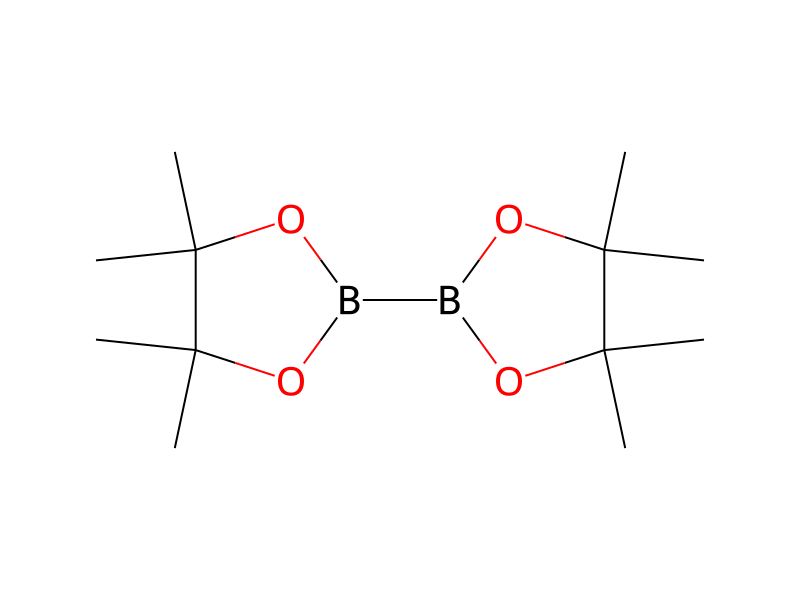
Br[C:2]1[C:3]([OH:12])=[N:4][C:5]2[C:10]([CH:11]=1)=[CH:9][CH:8]=[CH:7][CH:6]=2.[B:13]1(B2OC(C)(C)C(C)(C)O2)[O:17]C(C)(C)C(C)(C)[O:14]1.C([O-])(=O)C.[K+].C(Cl)Cl>C1C=CC(P(C2C=CC=CC=2)[C-]2C=CC=C2)=CC=1.C1C=CC(P(C2C=CC=CC=2)[C-]2C=CC=C2)=CC=1.Cl[Pd]Cl.[Fe+2].C1C=CC(P(C2C=CC=CC=2)[C-]2C=CC=C2)=CC=1.C1C=CC(P(C2C=CC=CC=2)[C-]2C=CC=C2)=CC=1.[Fe+2].O1CCOCC1>[O:12]=[C:3]1[C:2]([B:13]([OH:17])[OH:14])=[CH:11][C:10]2[C:5](=[CH:6][CH:7]=[CH:8][CH:9]=2)[NH:4]1Participants
8
Reactant 4



Product 1

Reagents, catalysts & solvents 3



Conditions
- Temperature
- 90 °C
Procedure
To a microwave vial was added 3-bromo-2-hydroxyquinoline (50 mg, 0.223 mmol), bis(pinacolato)diboron (113 mg, 0.446 mmol), potassium acetate (66 mg, 0.669 mmol), PdCl2(dppf). CH2Cl2 (18.22 mg, 0.022 mmol), and dppf (12.37 mg, 0.022 mmol), followed by addition of 1,4-dioxane (6 mL). The reaction mixture was purged with N2 and stirred under N2 atmosphere at 90° C. overnight. The reaction mixture was filtered through a disposable filter funnel, concentrated in vacuo, and purified by silica gel chromotography (10% to 60% EtOAc in heptane) to afford (2-oxo-1,2-dihydroquinolin-3-yl)boronic acid (30 mg, MS: 190.1 [M+H+].)
Workup
- customThe reaction mixture was purged with N2
- filtrationThe reaction mixture was filtered through a disposable filter funnel
- concentrationconcentrated in vacuo
- custompurified by silica gel chromotography (10% to 60% EtOAc in heptane)
Sources & evidence
- ORD record
- ord-c2fb867fa4204514aa22184a3c521273
- Source dataset
- uspto-grants-2015_05
- Patent number
- US09040712B2
Reaction notes
Loading…