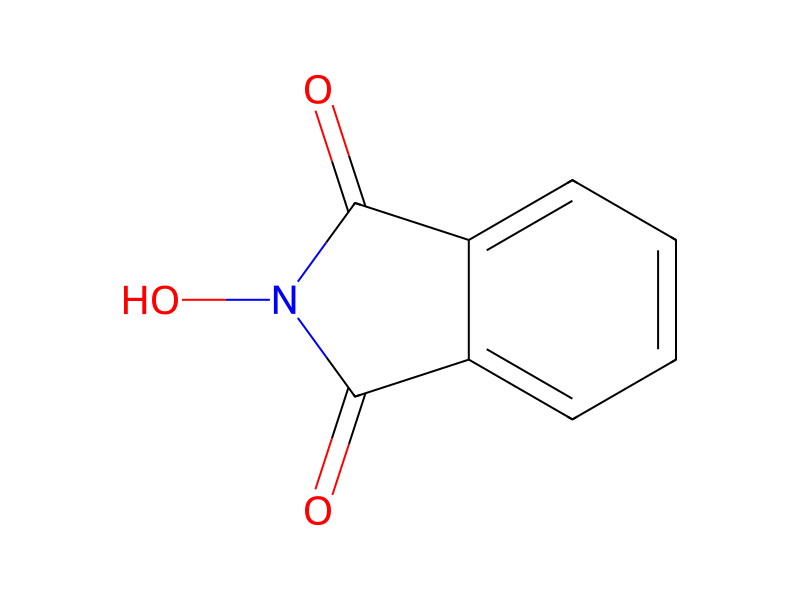
N-Hydroxyphthalimide → HCID 14049968, compound
Reaction equation

[OH:1][N:2]1[C:6](=[O:7])[C:5]2=[CH:8][CH:9]=[CH:10][CH:11]=[C:4]2[C:3]1=[O:12].C(=O)([O-])[O-].[K+].[K+].[F:19][C:20]1[CH:27]=[CH:26][C:23]([CH2:24]Br)=[CH:22][C:21]=1[O:28][C:29]1[CH:34]=[CH:33][CH:32]=[CH:31][CH:30]=1>C(COC)OC.CS(C)=O>[F:19][C:20]1[CH:27]=[CH:26][C:23]([CH2:24][O:1][N:2]2[C:3](=[O:12])[C:4]3=[CH:11][CH:10]=[CH:9][CH:8]=[C:5]3[C:6]2=[O:7])=[CH:22][C:21]=1[O:28][C:29]1[CH:30]=[CH:31][CH:32]=[CH:33][CH:34]=1Participants





Procedure
N-hydroxyphthalimide (2.19, 0.018 mole) was dissolved in a mixture of dry dimethoxyethane (15 ml) and dry dimethyl sulphoxide (4 ml). The clear yellow solution was cooled to 25° and potassium carbonate (1.24 g, 0.009 mol) was added. A red suspension resulted. 4-Fluoro-3-phenoxybenzyl bromide (5 g, 0.018 mol) was added dropwise over 5h at 22°-28°. The reaction mixture was stirred at room temperature overnight, after which most of the dimethoxyethane was removed in vacuo, and the solution then quenched by pouring into dilute hydrochloric acid (100 ml 1%). The resulting slurry was filtered, and the crystals washed with distilled water and dried in vacuo to give N-(4-fluoro-3-phenoxybenzyloxy)phthalimide as white crystals (6.4 g), (98%), m.p. 88.2°.
Workup
- temperatureThe clear yellow solution was cooled to 25°
- customA red suspension resulted
- customafter which most of the dimethoxyethane was removed in vacuo
- customthe solution then quenched
- additionby pouring into dilute hydrochloric acid (100 ml 1%)
- filtrationThe resulting slurry was filtered
- washthe crystals washed with distilled water
- customdried in vacuo
Sources & evidence
- ORD record
- ord-ecca301c82104b06b68047df23401a5d
- Source dataset
- uspto-grants-1988_06
- Patent number
- US04753960
Reaction notes
Loading…