Hydrochloric Acid → N-(2-Bromobutyryl)-glycine benzyl ester
Reaction equation

[Br:1][CH:2]([CH2:6][CH3:7])[C:3](Cl)=[O:4].C1(C)C=CC(S(O)(=O)=O)=CC=1.[CH2:19]([O:26][C:27](=[O:30])[CH2:28][NH2:29])[C:20]1[CH:25]=[CH:24][CH:23]=[CH:22][CH:21]=1.C(N(CC)CC)C.Cl>C(Cl)Cl>[CH2:19]([O:26][C:27](=[O:30])[CH2:28][NH:29][C:3](=[O:4])[CH:2]([Br:1])[CH2:6][CH3:7])[C:20]1[CH:25]=[CH:24][CH:23]=[CH:22][CH:21]=1Participants
6



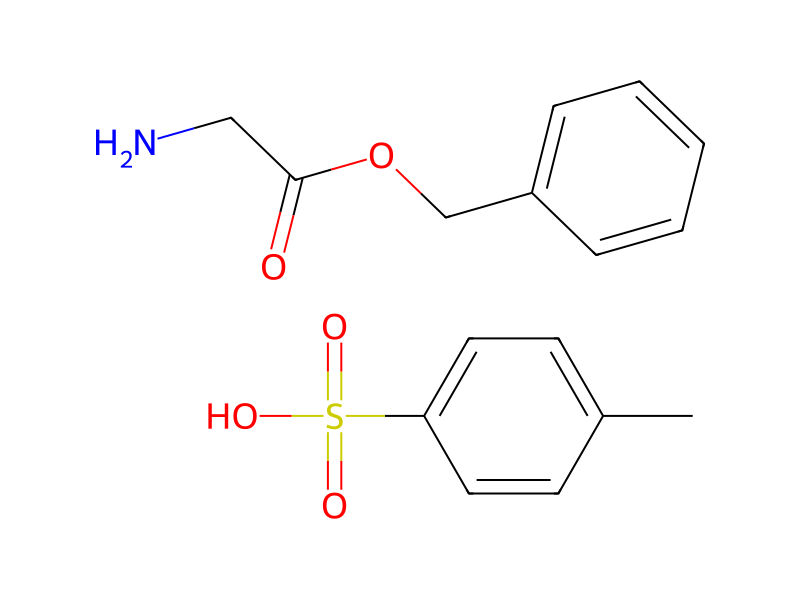


Procedure
65.96 g (355.7 mmol) of α-bromobutyric acid chloride is added in drops at 0° C. to 100 g (296.4 mmol) of glycine benzyl ester p-toluenesulfonic acid salt and 89.98 g (889.2 mmol) of triethylamine in 500 ml of methylene chloride. In this case, the temperature remains between 0° C.-5° C. 1000 ml of 5% aqueous hydrochloric acid is added, and the organic phase is separated. The organic phase is extracted once more with 500 ml of 5% aqueous hydrochloric acid, dried on magnesium sulfate and evaporated to dryness in a vacuum. The residue is recrystallized from diisopropyl ether.
Workup
- customremains between 0° C.-5° C
- customthe organic phase is separated
- extractionThe organic phase is extracted once more with 500 ml of 5% aqueous hydrochloric acid
- customdried on magnesium sulfate
- customevaporated to dryness in a vacuum
- customThe residue is recrystallized from diisopropyl ether
Sources & evidence
- ORD record
- ord-a84ec2f5c25645679ba1d4d85e6bd1c0
- Source dataset
- uspto-grants-1999_07
- Patent number
- US05919433
Reaction notes
Loading…