Pyridine → Chloromethyl 4-acryloyloxybutyl carbonate
Reaction equation

N1C=CC=CC=1.Cl[C:8]([O:10][CH2:11][Cl:12])=[O:9].[C:13]([O:17][CH2:18][CH2:19][CH2:20][CH2:21][OH:22])(=[O:16])[CH:14]=[CH2:15]>ClCCl>[C:8](=[O:9])([O:22][CH2:21][CH2:20][CH2:19][CH2:18][O:17][C:13](=[O:16])[CH:14]=[CH2:15])[O:10][CH2:11][Cl:12]Participants
Reactant 3


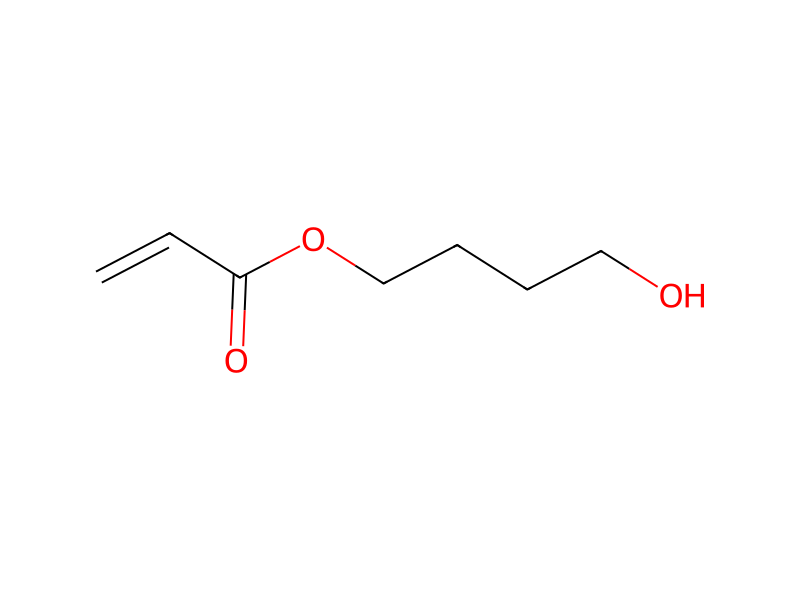
Product 1

Reagents, catalysts & solvents 1

Procedure
Pyridine (0.89 ml, 11.00 mmol) is added dropwise to a solution of chloromethyl chloroformate (0.98 ml, 11.00 mmol) and 4-hydroxybutyl acrylate (1.38 ml, 10.00 mmol) in dichloromethane (12 ml) at 3° C. under a dry N2 atmosphere. After 15 min. at 3° C. and 17 hours at 20° C. the reaction mixture is transferred to a separating funnel with the aid of dichloromethane (10 ml). The reaction mixture is washed with hydrochloric acid (1.00M, 10 ml), saturated aqueous sodium hydrogen carbonate (10 ml) and water (2×10 ml). The organic phase is dried (MgSO4) and the solvent evaporated under reduced pressure to give 1.76 g (74%) of the title product. 1H NMR (60 MHz, CDCl3): δ 1.82 (4H, m, CH2 --CH2), 4.27 (4H, m, 2×CH2 --O), 5.77 (2H, s, Cl--CH2 --O), 5.8-6.7 (3H, m, CH=CH2)
Workup
- washThe reaction mixture is washed with hydrochloric acid (1.00M, 10 ml), saturated aqueous sodium hydrogen carbonate (10 ml) and water (2×10 ml)
- dry with materialThe organic phase is dried (MgSO4)
- customthe solvent evaporated under reduced pressure
Sources & evidence
- ORD record
- ord-c0135de52cd14d24a905d641b8df5881
- Source dataset
- uspto-grants-1999_07
- Patent number
- US05919753
Reaction notes
Loading…