1-Butanol → Butanal
Reaction equation

[CH2:1]([OH:5])[CH2:2][CH2:3][CH3:4]>O1CCCC1.[Pd]>[CH:3]([CH:2]1[CH2:1][O:5]1)=[CH2:4].[CH:1](=[O:5])[CH2:2][CH2:3][CH3:4].[CH2:1]1[O:5][CH:2]1[CH2:3][CH3:4]Participants
Reactant 1

Product 3
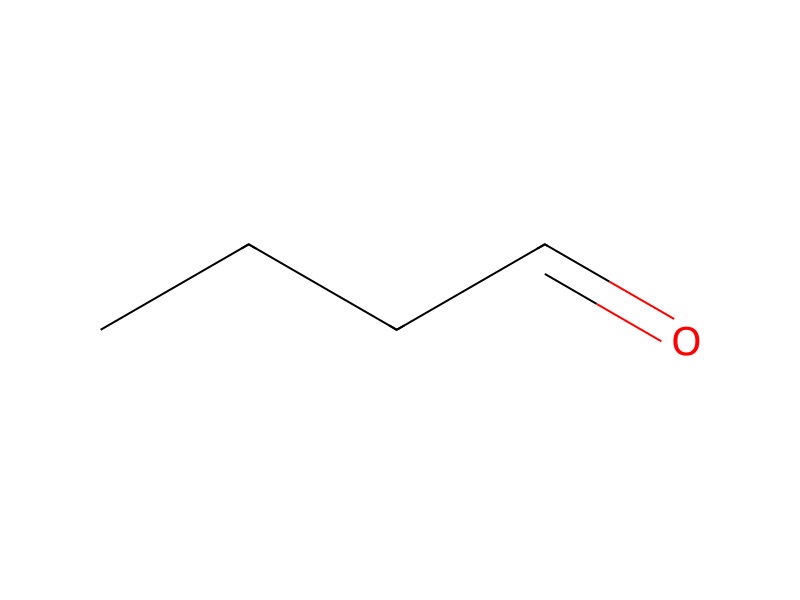


Reagents, catalysts & solvents 2


Procedure
In U.S. Pat. No. 5,077,418 and U.S. Pat. No. 5,117,013 it is reported that the hydrogenation of vinyloxirane solutions over palladium-containing catalysts gives n-butyraldehyde as main product. For instance, hydrogenation of vinyloxirane together with tetrahydrofuran as solvent over a supported palladium catalyst (5% by weight of palladium on activated carbon) at a temperature of from 50 to 55° C. and a pressure of 3.5 bar gives after a reaction time of 3 h a hydrogenation effluent comprising 55% of n-butyraldehyde, only 27% of 1,2-butylene oxide and 9% of n-butanol. If the hydrogenation is carried out over alumina-supported palladium catalysts (5% of Pd/Al2O3), only traces of 1,2-butylene oxide are formed after 6 hours at from 25 to 55° C. and a pressure of 3.5 bar or after 4 hours at 100° C. and 20.7 bar. n-Butyraldehyde is formed as the main product with a selectivity of, respectively, 87% or 78% and quantitative conversion. The two U.S. applications also describe the hydrogenation of vinyloxirane over Raney nickel, when n-butanol is formed as the main product. The 1,2-butylene oxide yield is relatively low at 41%. The hydrogenation of vinyloxirane over a supported platinum catalyst (1% by weight of Pt/Al2O3) at 100° C. and 20.7 bar hydrogen pressure produces after 4.6 h and complete conversion only 40% of 1,2-butylene oxide and also 23% of n-butanol, 24% of butanols, 5% of crotonaldehyde and 3% of n-butyraldehyde. Other platinum catalysts give even lower 1,2-butylene oxide yields.
Sources & evidence
- ORD record
- ord-fbf126f71abe4921ab0aeab522d3da89
- Source dataset
- uspto-grants-1999_07
- Patent number
- US05929261
Reaction notes
Loading…