Ammonia → HCID 53968399, compound
Reaction equation

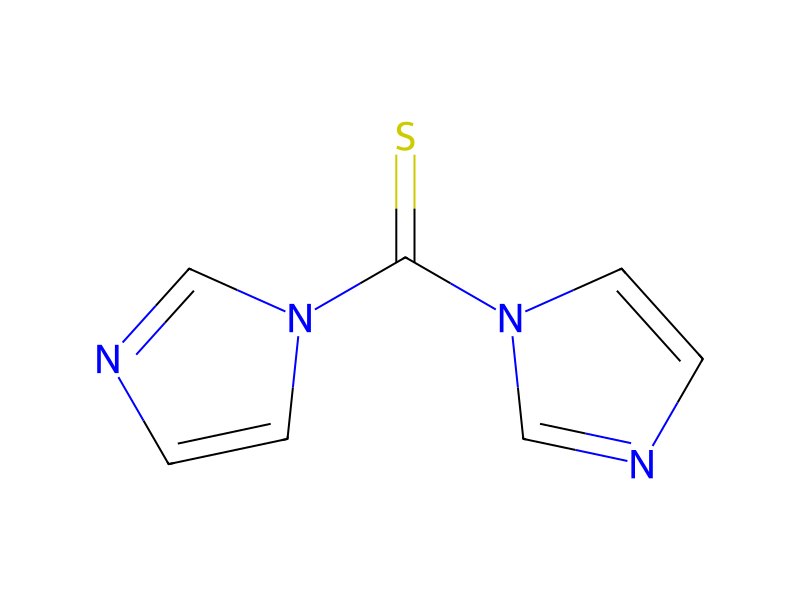
[C:1]([N:8]1C=CN=C1)(N1C=CN=C1)=[S:2].[CH2:13]([O:20]CC1C=CC=CC=1)[C:14]1[CH:19]=[CH:18][CH:17]=[CH:16][CH:15]=1.[Na].N.FC(F)(F)S(Cl)(=O)=O.C1(C)C=CC(S(Cl)(=O)=O)=CC=1>C1COCC1>[C:1](=[S:2])([O:20][CH2:13][C:14]1[CH:19]=[CH:18][CH:17]=[CH:16][CH:15]=1)[NH2:8]Participants






Procedure
To a stirred solution of 1,1′-thiocarbonyldiimidazole (0.01 mol), in THF is added sodium benzyloxide (0.01 mol), and the mixture is stirred for from 1 minute to about 24 hours. To the mixture is added ammonia gas, and the mixture is stirred at atmospheric pressure or shaken at from atmospheric pressure to about 75 psi. Reaction progress may be followed by TLC or HPLC. (Alternatively, the imidazolyl leaving groups may be first activated (sequentially) by sulfonylation on nitrogen by pretreatment before each displacement with a suitable sulfonylating reagent such as trifluoromethanesulfonyl chloride or para-toluenesulfonyl chloride. This allows displacement of imidazolyl under less rigorous reaction conditions.) When a sufficient amount of desired product is formed, the mixture is partitioned between ethyl acetate and water, or optionally the mixture is first rotary evaporated, and the residue is so partitioned. The organic layer is washed with brine, dried over sodium sulfate, and rotary evaporated to give thiocarbamic acid, benzyl ester, which may be purified, if needed or desired, by chromatography on silica gel or crystallization.
Workup
- stirringthe mixture is stirred at atmospheric pressure
- stirringshaken at from atmospheric pressure to about 75 psi
- customReaction progress
- customThis allows displacement of imidazolyl under less rigorous reaction conditions
Sources & evidence
- ORD record
- ord-5ee33573299b4b2eb3ad8b353fc6e015
- Source dataset
- uspto-grants-2005_08
- Patent number
- US06924276B2
Reaction notes
Loading…