Chloroacetonitrile → 4-bromo-1-cyanomethyl-1H-indole-2-carboxylic acid ethyl ester
Reaction equation

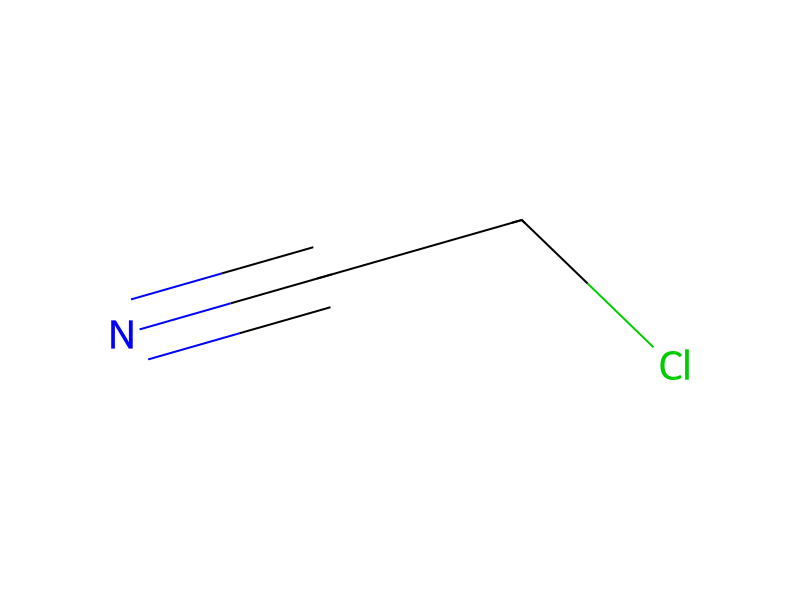
[H-].[Na+].[CH2:3]([O:5][C:6]([C:8]1[NH:9][C:10]2[C:15]([CH:16]=1)=[C:14]([Br:17])[CH:13]=[CH:12][CH:11]=2)=[O:7])[CH3:4].Cl[CH2:19][C:20]#[N:21]>CN(C)C=O>[CH2:3]([O:5][C:6]([C:8]1[N:9]([CH2:19][C:20]#[N:21])[C:10]2[C:15]([CH:16]=1)=[C:14]([Br:17])[CH:13]=[CH:12][CH:11]=2)=[O:7])[CH3:4]Participants
5




Procedure
Sodiumhydride (4.0 g, 92 mmol) was suspended in dimethylformamide (20 mL) and a solution of 4-bromo-1H-Indole-2-carboxylic acid ethyl ester (16.4 g, 61 mmol) in dimethylformamide (70 mL) was added. The mixture was stirred for 1 h at room temperature and after cooling to 0° C. chloroacetonitrile (7.7 mL, 122 mmol) was added. After 1 h at room temperature the mixture was added to an ice/water mixture (800 mL) and extracted with ethylacetate. The organic phases were pooled washed with brine, dried with MgSO4 and the solvent was removed in vacuo. Chromatography on silica gel (ethyl acetate/n-hexane 4:1) yielded 4-bromo-1-cyanomethyl-1H-indole-2-carboxylic acid ethyl ester (13.4 g, 71%) as a colorless solid, MS: m/e=306.0 (M+).
Workup
- additionwas added
- extractionextracted with ethylacetate
- washThe organic phases were pooled washed with brine
- dry with materialdried with MgSO4
- customthe solvent was removed in vacuo
Sources & evidence
- ORD record
- ord-f1fb4f3926f2470784ca59040c156b75
- Source dataset
- uspto-grants-2005_08
- Patent number
- US06933387B2
Reaction notes
Loading…