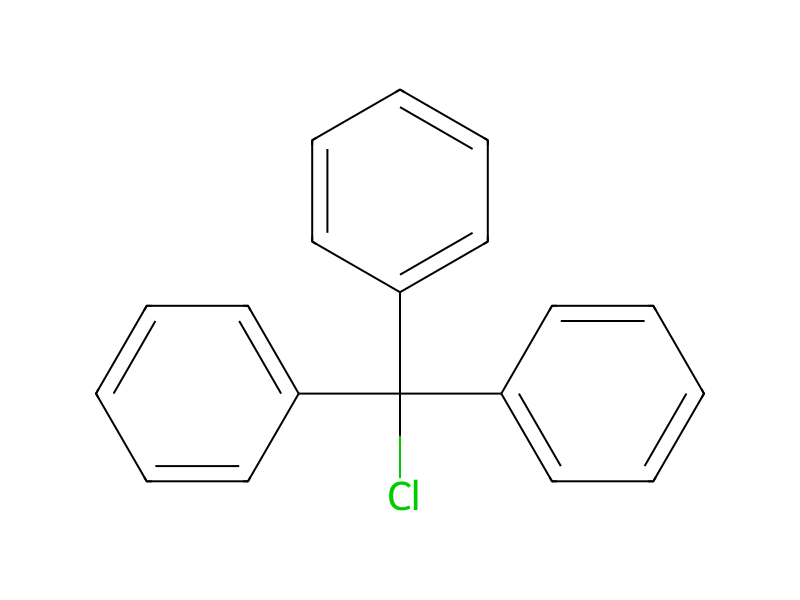
Trityl chloride → 4-Bromo-1-trityl-1H-pyrazole
Reaction equation

[C:1](Cl)([C:14]1[CH:19]=[CH:18][CH:17]=[CH:16][CH:15]=1)([C:8]1[CH:13]=[CH:12][CH:11]=[CH:10][CH:9]=1)[C:2]1[CH:7]=[CH:6][CH:5]=[CH:4][CH:3]=1.[Br:21][C:22]1[CH:23]=[N:24][NH:25][CH:26]=1.CC(C)([O-])C.[K+]>CN(C=O)C.O>[Br:21][C:22]1[CH:23]=[N:24][N:25]([C:1]([C:14]2[CH:19]=[CH:18][CH:17]=[CH:16][CH:15]=2)([C:8]2[CH:13]=[CH:12][CH:11]=[CH:10][CH:9]=2)[C:2]2[CH:7]=[CH:6][CH:5]=[CH:4][CH:3]=2)[CH:26]=1Participants
6
Reactant 3


Product 1

Reagents, catalysts & solvents 2


Conditions
- Temperature
- 28 °C
Procedure
Ph3CCl (10.4 g, 37 mmol) was added to a mixture of 4-bromopyrazole (5.0 g, 34 mmol) and potassium tert-butoxide (4.58 g, 41 mmol) in DMF (15 mL) at 0° C. then the mixture was stirred at 28° C. for 12 hours. The mixture was diluted with water and extracted with ethyl acetate, filtrated and recrystallized. The solid was dried under reduced pressure to afford 4-bromo-1-trityl-1H-pyrazole. MS ESI calc'd. for C22H18BrN2 [M+H]+389 and 391. found 389 and 391. 1H NMR (400 MHz, DMSO-d6): δ 7.74 (s, 1H), 7.50 (s, 1H), 7.38-7.34 (m, 10H), 7.04-7.01 (m, 5H).
Workup
- extractionextracted with ethyl acetate
- filtrationfiltrated
- customrecrystallized
- customThe solid was dried under reduced pressure
Sources & evidence
- ORD record
- ord-7a86560c318c4cf2bbceaefc7e45ee9b
- Source dataset
- uspto-grants-2016_01
- Patent number
- US09242984B2
Reaction notes
Loading…