Potassium Phosphate, Tribasic → HCID 86724828, compound
Reaction equation

CO[C:3]1[CH:4]=[CH:5][CH:6]=[C:7](OC)[C:8]=1[C:9]1[CH:10]=[CH:11][CH:12]=[CH:13][C:14]=1P(C1CCCCC1)C1CCCCC1.P([O-])([O-])([O-])=O.[K+].[K+].[K+].Br[C:39]1[CH:40]=[CH:41][C:42]2[O:46][C:45]([C:47]3[CH:48]=[C:49]4[C:54](=[CH:55][CH:56]=3)[N:53]=[CH:52][CH:51]=[CH:50]4)=[N:44][C:43]=2[CH:57]=1.[C:58]1(B(O)O)[CH:63]=[CH:62][CH:61]=[C:60](B(O)O)[CH:59]=1>O1CCOCC1.CC([O-])=O.CC([O-])=O.[Pd+2].O>[N:53]1[C:54]2[C:49](=[CH:48][C:47]([C:45]3[O:46][C:42]4[CH:41]=[CH:40][C:39]([C:11]5[CH:12]=[CH:13][CH:14]=[C:9]([C:8]6[CH:3]=[CH:4][C:5]7[O:46][C:45]([C:60]8[CH:59]=[C:58]9[C:63](=[CH:62][CH:61]=8)[N:53]=[CH:52][CH:51]=[CH:50]9)=[N:44][C:6]=7[CH:7]=6)[CH:10]=5)=[CH:57][C:43]=4[N:44]=3)=[CH:56][CH:55]=2)[CH:50]=[CH:51][CH:52]=1Participants
Reactant 4



Product 1

Reagents, catalysts & solvents 3



Conditions
- Temperature
- 90 °C
Procedure
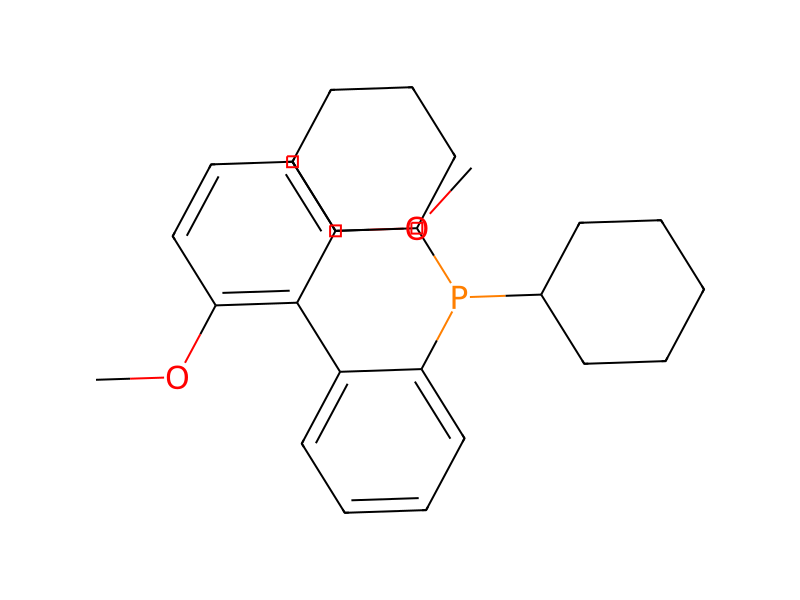
Inside a glove box, Pd(OAc)2 (17.3 mg, 76.9 μmol) and s-Phos [2-dicyclohexylphosphino-2′,6′-dimethoxybiphenyl, available from Aldrich] (63.1 mg, 154 μmol) were dissolved in 1,4-dioxane (1 mL). Tripotassium phosphate (9.79 g, 46.1 mmol, 3 eq) was weighed into a 20 mL vial, and 8.59 mL of water was added. 5-Bromo-2-(quinolin-6-yl)benzo[d]oxazole (Precursor 3, 5.00 g, 15.38 mmol) and 1,3-phenylenediboronic acid (1.21 g, 7.30 mmol, 0.475 eq) were dissolved in 55 mL of 1,4-dioxane, and the aqueous tripotassium phosphate solution was added, followed by the catalyst solution. The reaction was stirred at 90° C. for five days. The crude reaction mixture was evaporated to dryness, dissolved in 1 L of boiling chloroform, and adsorbed onto silica gel, followed by rotary evaporation of the solvent. The compound was purified via column chromatography, using an “80 g silica cartridge” and a “2% methanol in chloroform isocratic gradient.” The pure fractions were combined, concentrated, and dried under high vacuum. The compound was received in form of a colorless glass (organic purity: 99.3%). Sublimation on a train sublimator increased the organic purity to 99.6% (1.40 g, 2.47 mmol, 16.1%, colorless microcrystals). 1H-NMR (500 MHz, CDCl3) δ 9.02 (dd, J=4.2, 1.7 Hz, 2H), 8.81 (d, J=2.0 Hz, 2H), 8.61 (dd, J=8.9, 2.0 Hz, 2H), 8.37-8.30 (m, 2H), 8.27 (d, J=8.9 Hz, 2H), 8.14-8.07 (m, 2H), 7.96-7.90 (m, 1H), 7.78-7.58 (m, 7H), 7.52 (dd, J=8.2, 4.2 Hz, 2H); 13C-NMR (126 MHz, CDCl3) δ 110.82, 118.79, 122.13, 125.17, 125.23, 126.52, 126.79, 127.72, 128.01, 128.07, 129.54, 130.55, 136.89, 138.58, 141.71, 142.91, 149.55, 150.68, 152.09, 163.12; ESI/LC/MS/MS: m/z=567 (base peak, [M+H]+), fragmenting into 567, 385, 203, 202, 129, 155, 231. CLogP: 8.434. (ChemBioDraw Ultra, Version 12.0.2.1076, Cambridge-Soft 2010). Additional computed data: HOMO: −5.90 eV, LUMO: −1.93 eV, Triplet Energy: 2.42 eV.
Workup
- customThe crude reaction mixture
- customwas evaporated to dryness
- dissolutiondissolved in 1 L of boiling chloroform
- customfollowed by rotary evaporation of the solvent
- customThe compound was purified via column chromatography
- concentrationconcentrated
- customdried under high vacuum
- temperatureSublimation on a train sublimator increased the organic purity to 99.6% (1.40 g, 2.47 mmol, 16.1%, colorless microcrystals)
Sources & evidence
- ORD record
- ord-9f0ad82aa23b42e1ac75e4451358f319
- Source dataset
- uspto-grants-2016_01
- Patent number
- US09246108B2
Reaction notes
Loading…