Dibenzofuran → Dibenzofuran
Reaction equation

[CH:1]1[C:9]2[C:8]3[CH:10]=[CH:11][CH:12]=[CH:13][C:7]=3[O:6][C:5]=2[CH:4]=[CH:3][CH:2]=1.C1C2=C3C(=CC=C2)C=CC=C3C1.C1C2CC3C(=CC=CC=3)C=2C=CC=1>>[CH:1]1[C:9]2[C:8]3[CH:10]=[CH:11][CH:12]=[CH:13][C:7]=3[O:6][C:5]=2[CH:4]=[CH:3][CH:2]=1.[C:8]1([C:9]2[CH:1]=[CH:2][CH:3]=[CH:4][C:5]=2[OH:6])[CH:7]=[CH:13][CH:12]=[CH:11][CH:10]=1Participants



Procedure
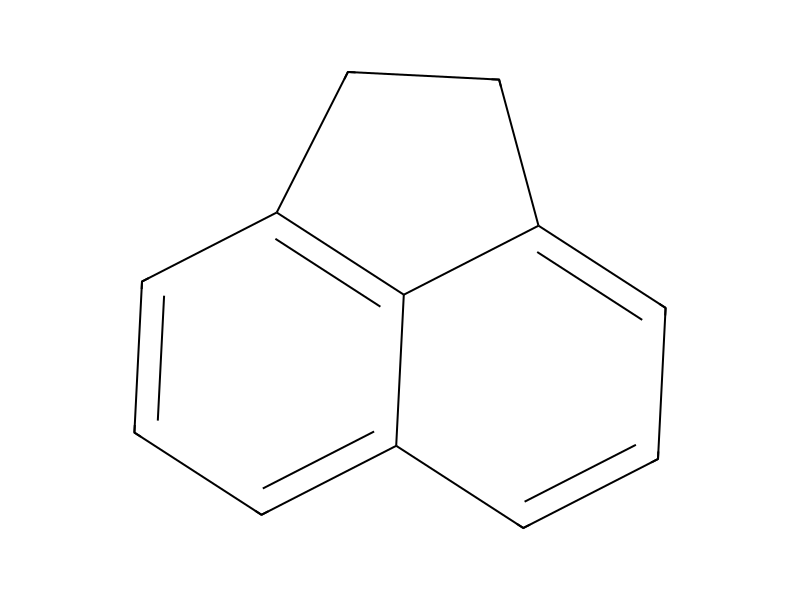
Commerical use of these materials has been hampered however, by reason of high costs, presence of impurities, and general unavailability. Commercially available dibenzofuran for example is presently obtained from coal tar and frequently contains impurities such as acenaphthene and fluorene which cannot conveniently be separated by commercially suitable methods such as washing, recrystallization, or distillation. In some cases dibenzofuran having greater purity as compared to that obtained from coal tar may be synthesized, but the prior art methods are costly because of expensive starting materials, complicated procedures, low yields or the like. For example, dibenzofuran has been obtained in a 30% yield by Graebe and Ullmann [Ber. 29, 1877 (1896)] by diazotization and subsequent hydrolysis of 2-aminodiphenyl oxide, while Tauber and Halberstadt [Ber. 25, 2745 (1892)] obtained a yield of 75% by similar treatment of 2,2'-diaminodiphenyl. These two methods however are not adapted to commercial operation due to the high cost and difficulty of obtaining the starting materials required. Hale and Stoesser (U.S. Pat. No. 1,808,394) obtained dibenzofuran by intramolecular dehydrogenation of orthophenylphenol over a refractory oxide catalyst, but again the high cost of the starting material limits the commercial utility of this route. Cullinane [J. Chem. Soc., 2267 (1930)] obtained dibenzofuran in 20% yield in 8 hours by pyrolysis of phenol over litharge at 150° C. The low yield limits commercial utility of this route. Walsh and Preston (U.S. Pat. No. 3,108,121) reacted diphenyl oxide over a relatively expensive and sensitive 5% platinum on charcoal catalyst to obtain dibenzofuran. Shiotani and Itatani [Angew. Chem. 86 478 (1974)] used a palladium acetate catalyst to produce dibenzofuran from diphenyl oxide but obtained much dimerized product as well. In particular, in these latter two methods two synthetic steps are required to obtain dibenzofuran from phenol inasmuch as diphenyl oxide is frequently obtained from a reaction involving a condensation of phenol.
Workup
- customcannot conveniently be separated by commercially suitable methods such
- washas washing
- customrecrystallization, or distillation
- customthat obtained from coal tar
- custommay be synthesized
- customlow yields
- customobtained a yield of 75% by similar treatment of 2,2'-diaminodiphenyl
- customof obtaining the starting materials
Sources & evidence
- ORD record
- ord-88597b382bc34be392c0385523b3f361
- Source dataset
- uspto-grants-1977_03
- Patent number
- US04013694
Reaction notes
Loading…