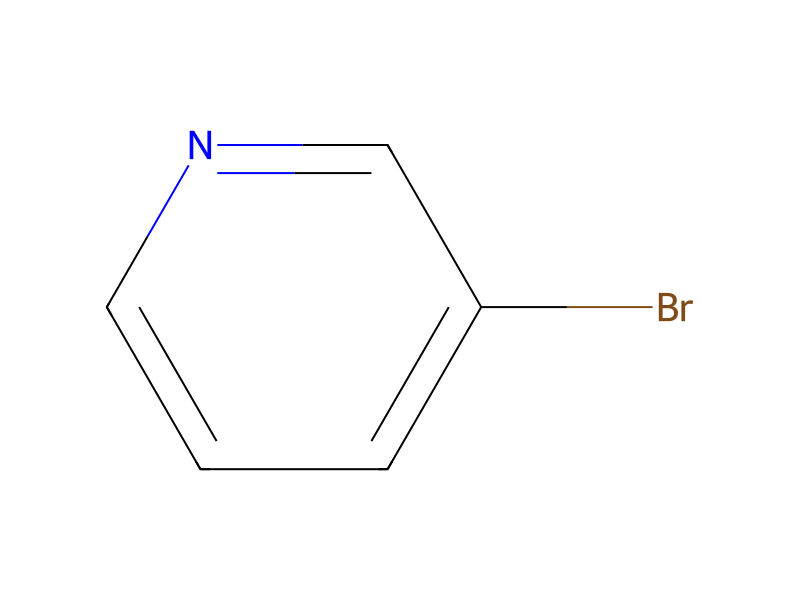
3-Bromopyridine → Ethyl 6-hydroxy-6-(3-pyridinyl)-3-azabicyclo[3.2.1]octane-3-carboxylate
Reaction equation

Br[C:2]1[CH:3]=[N:4][CH:5]=[CH:6][CH:7]=1.C([Li])CCC.N1C=CC=CC=1[Li].[O:20]=[C:21]1[CH2:27][CH:26]2[CH2:28][CH:22]1[CH2:23][N:24]([C:29]([O:31][CH2:32][CH3:33])=[O:30])[CH2:25]2>C(OCC)C.C1COCC1>[OH:20][C:21]1([C:2]2[CH:3]=[N:4][CH:5]=[CH:6][CH:7]=2)[CH2:27][CH:26]2[CH2:28][CH:22]1[CH2:23][N:24]([C:29]([O:31][CH2:32][CH3:33])=[O:30])[CH2:25]2Participants
Reactant 4



Product 1

Reagents, catalysts & solvents 2


Procedure
To a solution of 3-bromopyridine (1.04 g, 6.58 mmol) in dry diethyl ether (20 ml) at −78° C. was added 2.5 M n-butyllithium (2.63 ml, 6.6 mmol). The reaction was stirred for 30 min under nitrogen. The pyridinyllithium solution was then slowly transferred by cannula into a solution of ethyl 6-oxo-3-azabicyclo[3.2.1]octane-3-carboxylate (1.00 g, 5.07 mmol) in THF (10 ml) at −78° C. The reaction was stirred 4 h at −78° C. and then quenched with saturated aqueous ammonium chloride (10 ml). The reaction was then extracted with chloroform (3×25 ml), the combined extracts dried over sodium sulfate, filtered, and concentrated by rotary evaporation. Excess pyridine was removed by repeated azeotropic rotary evaporation with toluene to yield the desired product (1.20 g, 86%).
Workup
- stirringThe reaction was stirred 4 h at −78° C.
- customquenched with saturated aqueous ammonium chloride (10 ml)
- extractionThe reaction was then extracted with chloroform (3×25 ml)
- dry with materialthe combined extracts dried over sodium sulfate
- filtrationfiltered
- concentrationconcentrated by rotary evaporation
- customExcess pyridine was removed
- customrotary evaporation with toluene
Sources & evidence
- ORD record
- ord-7e8e18c5fe774a68997b76cf26e6ccdd
- Source dataset
- uspto-grants-2011_03
- Patent number
- US07897611B2
Reaction notes
Loading…