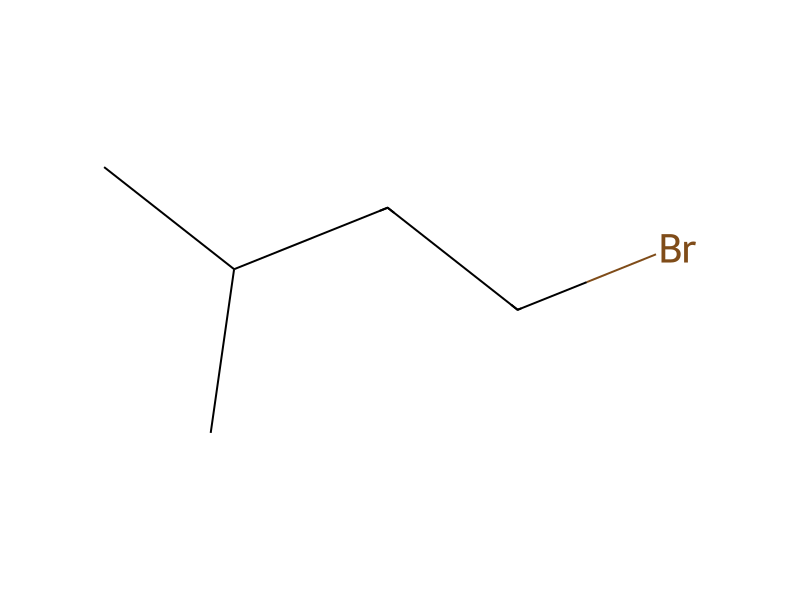
1-Bromo-3-methylbutane → 4-(benzyloxy)-1-isopentyl-2(1H)-pyridinone
Reaction equation

[CH2:1]([O:8][C:9]1[CH:14]=[CH:13][NH:12][C:11](=[O:15])[CH:10]=1)[C:2]1[CH:7]=[CH:6][CH:5]=[CH:4][CH:3]=1.N12CCCN=C1CCCCC2.Br[CH2:28][CH2:29][CH:30]([CH3:32])[CH3:31]>CN(C)C(=O)C>[CH2:1]([O:8][C:9]1[CH:14]=[CH:13][N:12]([CH2:28][CH2:29][CH:30]([CH3:32])[CH3:31])[C:11](=[O:15])[CH:10]=1)[C:2]1[CH:3]=[CH:4][CH:5]=[CH:6][CH:7]=1Participants
5



Conditions
- Temperature
- 25 °C
Procedure
A solution of 4-benzyloxy-1H-pyridin-2-one (1.0 g, 4.97 mmol) and 1,8-diazabicyclo[5.4.0]undec-7-ene (1.86 mL, 12.43 mmol) and 1-bromo-3-methyl butane (0.715 mL, 5.96 mmol) in N,N-dimethylacetamide (20 mL) was heated at 65° C. for 5 days. The solution was cooled to about 25° C. and partitioned between 10% aqueous ammonium chloride and dichloromethane, the organic layer separated and concentrated under reduced pressure. The residue was chromatographed on silica gel, eluting with 1% methanol in dichloromethane to provide the title compound (0.569 g, 42%).
Workup
- custompartitioned between 10% aqueous ammonium chloride and dichloromethane
- customthe organic layer separated
- concentrationconcentrated under reduced pressure
- customThe residue was chromatographed on silica gel
- washeluting with 1% methanol in dichloromethane
Sources & evidence
- ORD record
- ord-df384aff8f1c4c18bf2c8eff4afbe1a0
- Source dataset
- uspto-grants-2011_03
- Patent number
- US07902203B2
Reaction notes
Loading…