Hydrochloric Acid → 6-Bromo-1,1,4,4-tetramethyl-1,2,3,4-tetrahydronaphthalene
Reaction equation

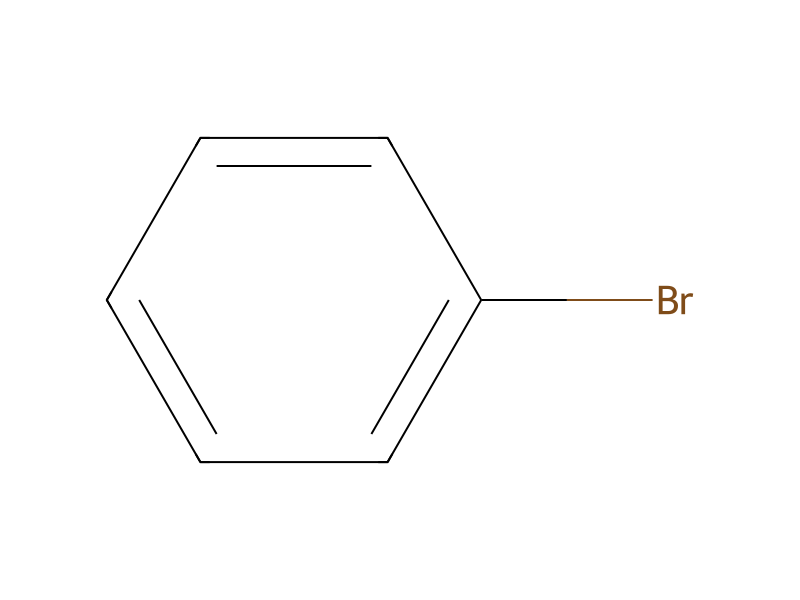
[Br:1][C:2]1[CH:7]=[CH:6][CH:5]=[CH:4][CH:3]=1.Cl[C:9]([CH3:17])([CH2:11][CH2:12][C:13]([CH3:16])(Cl)[CH3:14])[CH3:10].[Al+3].[Cl-].[Cl-].[Cl-].Cl>C(Cl)Cl>[Br:1][C:2]1[CH:7]=[CH:6][C:5]2[C:13]([CH3:16])([CH3:14])[CH2:12][CH2:11][C:9]([CH3:17])([CH3:10])[C:4]=2[CH:3]=1Participants





Procedure
To a solution of 2-bromobenzene (40 g, 255 mmol) and 2,5-dichloro-dimethyl hexane (52.7 g, 280 mmol) in 600 mL anhydrous CH2Cl2 at 5° C. was added, portionwise, AlCl3 (10.2 g, 76 mmol). Upon addition of AlCl3, HCl gas evolution was observed. The solution changed from yellow to reddish orange. The reaction solution was kept at 5-20° C. for two hours and then allowed to stir at room temperature overnight. The reaction mixture was poured into 600 g of ice and extracted with CHCl3 (2×700 mL). The organic phase was washed with water, aqueous saturated NaHCO3, saturated NaCl and dried (Na2SO4). The organic solution was then concentrated in vacuo and chromatographed (hexane) to provide 50 g of 2-bromo-5,5,8,8-tetramethyl-5,6,7,8-tetrahydronaphthalene as a yellow gummy solid in 73% yield. 1H NMR (400 MHz, CDCl3) δ7.41 (d, J=2.0 Hz, 1H, aromatic), 7.22 (dd, J=8.0 and 1.9 Hz, 1H, aromatic), 7.18 (d, J=8.0 Hz, 1H, aromatic), 1.68 (s, 4H, 2CH2), 1.27 (s, 6H, 2CH3), 1.24 (s, 6H, 2CH3).
Workup
- extractionextracted with CHCl3 (2×700 mL)
- washThe organic phase was washed with water, aqueous saturated NaHCO3, saturated NaCl
- dry with materialdried (Na2SO4)
- concentrationThe organic solution was then concentrated in vacuo
- customchromatographed (hexane)
Sources & evidence
- ORD record
- ord-027e16f3462742ccac5bb28698ab046a
- Source dataset
- uspto-grants-1999_12
- Patent number
- US06005007
Reaction notes
Loading…